Launching a private label baby diaper brand can feel overwhelming, especially when you’re managing timelines, tooling, certifications, and different suppliers at the same time. For B2B buyers—whether importers, wholesalers, or brand owners attempting to scale—speed and stability matter. That is why working with an experienced Fabricación de pañales OEM partner with an accelerated supply chain and a structured quality control (QC) system can become your competitive advantage.
At New EcoCare, we have spent decades building and refining a supply chain system that allows overseas brands to launch new baby diaper products quickly, while keeping quality consistent and predictable. In this article, we’ll walk you through how an “accelerated supply chain” works, why it matters for your private label success, and the QC milestones that ensure your diapers always meet international standards.
This guide is written for B2B clients who are evaluating OEM and private label manufacturers in China. It highlights the full picture—from prototype to mass production—and offers clarity on what truly makes an OEM supply chain work.
Índice
1. Understanding the “Accelerated Supply Chain” in Baby Diaper OEM
In the past, building a private label baby diaper brand could take months. Today, with optimized production processes, integrated vendors, and digital communication tools, a qualified manufacturer can shorten the journey significantly—sometimes to as little as 30–45 days for standard SKUs.
But speed doesn’t simply come from running machines faster. It requires a unified supply chain structure where raw materials, QC systems, and production teams operate in sync.
1.1 What an Accelerated Supply Chain Actually Means
An accelerated supply chain for diaper OEM includes:
Pre-approved material databases (topsheet, backsheet, SAP, fluff pulp, elastic, wetness indicators)
Flexible production lines that can switch between sizes and absorbency levels
In-house design for packaging and product specifications
Predictable procurement lead times from long-term material partners
Parallel workflows (sample creation, packaging approval, and carton design can happen simultaneously)
For B2B clients, this means faster time-to-market—not because corners are cut, but because the right systems and partnerships are already in place.
1.2 Why Speed Matters in Today’s B2B Environment
Distributors and wholesalers operate in a competitive environment:
New brands enter the market rapidly
Retail chains refresh their shelves more frequently
Global buyers face increasing logistics costs
Demand changes faster due to e-commerce algorithms
Launching products quickly can help you:
Secure better shelf positions
Respond to regional trends
Reduce inventory risk
Test multiple SKUs without long commitments
Enter new markets while competitors are still preparing
This is why choosing an OEM manufacturer with a strong supply chain structure isn’t just a preference—it’s a growth strategy.

2. The Step-by-Step Path to Building Your Private Label Baby Diaper
Below is a practical guide showing how brands typically build their private label pañal de bebé line with New EcoCare. Timelines may vary depending on customization, but the structure remains consistent.
2.1 Step One: Defining Your Product Requirements
Every successful private label begins with a clear brief. B2B clients usually provide:
Target market and standards (CE, ISO, FSC, etc.)
Material preferences (bamboo, cottony topsheet, biodegradable film, soft elastic waistbands)
Absorption levels
Sizes required (NB–XL)
Packaging style (bags, boxes, sustainable options)
MOQ expectations
Price range and positioning
The clearer your brief, the faster we can move into sample development.
2.2 Step Two: Sample Development with Parallel Workflows
Most manufacturers work with a linear process—samples first, packaging later.
But in an accelerated supply chain, these tasks move in parallel:
Product sample creation
Packaging layout design
Barcode and regulatory compliance checks
Carton size optimization based on pallet or container loading
When samples are ready, they are tested internally—and sent to you for external testing.
2.3 Step Three: Material Procurement with Pre-Approved Vendors
Material delays are the most common cause of slow production. To prevent this, only manufacturers with an established procurement network can support accelerated supply chains.
At New EcoCare:
We work with audited suppliers for SAP, fluff pulp, films, and elastic
We maintain long-term contracts for stable material supply
We keep rolling safety stocks for key components to avoid downtime
We follow structured BOM (Bill of Materials) management to eliminate variation between batches
This ensure material consistency while supporting timely production for private label brands.
2.4 Step Four: Trial Production (Pilot Run)
Before mass production, we conduct a pilot run to verify:
Machine setting stability
Absorption performance
Fit and fastening strength
SAP distribution accuracy
Cutting precision
Waistband and cuff elasticity consistency
This helps avoid errors during large-scale production.
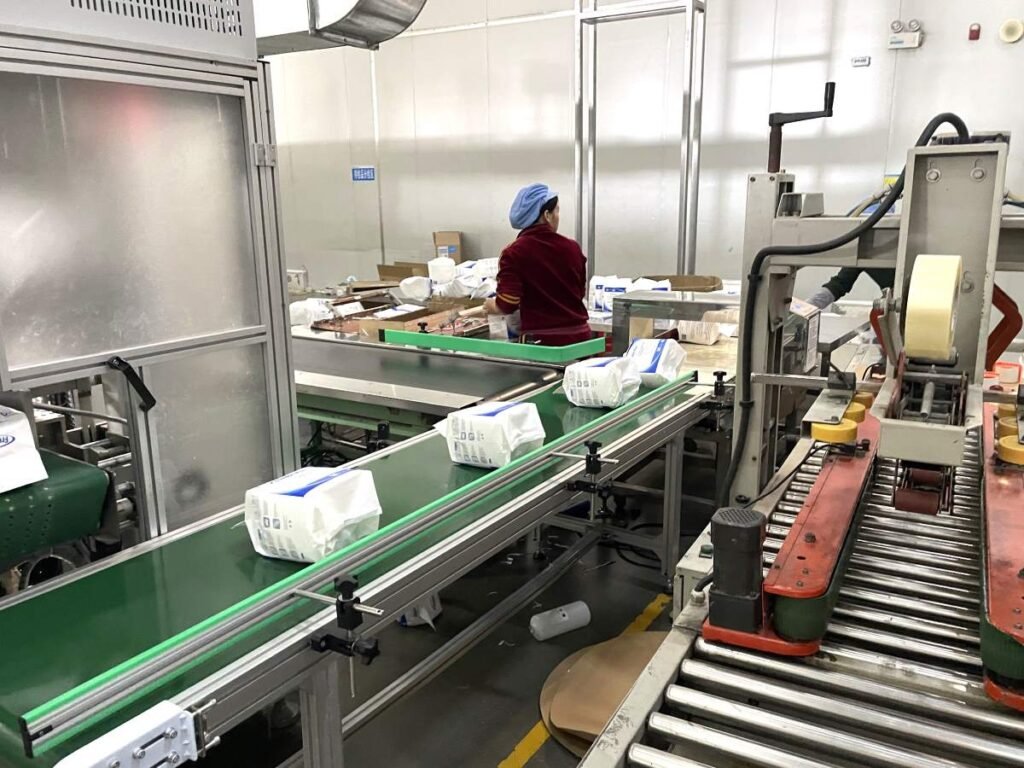
2.5 Step Five: Mass Production and Assembly
Once pilot samples pass, mass production begins. An efficient OEM partner will:
Maintain uniform machine calibration
Use inline QC checkpoints
Conduct random carton inspections
Test SAP/fluff pulp ratio during the run
Verify packaging sealing quality
Mass production is always combined with continuous quality monitoring, which leads us to the next section.
3. The Structured QC System Behind Every Successful Private Label
A reliable QC process is not just about checking the final product—it is about controlling each stage. Below is how New EcoCare manages the full QC chain for baby diaper OEM.
3.1 Incoming Material Inspection (IQC)
Every batch of material undergoes standardized inspection:
Absorbent core absorption rate
Backsheet breathability
Topsheet softness and uniformity
SAP quality verification
Elastic durability
Ink and print quality for packaging
Only approved materials enter the production line.
3.2 Online Process Control (IPQC)
During production, inspectors monitor:
Weight and absorption consistency
Leakage barrier bonding
Stick tab and waistband elasticity
Core positioning accuracy
Glue application uniformity
Cutting precision
This prevents defects before they occur—an essential capability for B2B buyers requiring large orders and stable supply.
3.3 Finished Product Inspection (FQC)
After packaging, each batch is tested for:
Fluid absorption speed
Rewet levels
SAP stability
Side leakage resistance
Fit and flexibility
Packing integrity tests (drop test, vibration test)
Only after FQC approval are diapers cleared for shipment.
3.4 Batch Traceability and Documentation
For B2B clients, documentation is crucial. Therefore, we maintain:
Batch traceability logs
IQC and IPQC reports
FQC inspection records
Packaging version control
Container loading reports
This ensures regulatory compliance, transparent communication, and long-term brand protection.


4. What Makes an OEM Partner Truly “Flexible”?
Flexibility is not simply the ability to produce different SKUs. It is the ability to support brand growth at every stage.
4.1 Flexibility in MOQ
New and emerging brands need lower MOQs for testing market demand.
A flexible OEM manufacturer can support this without compromising cost efficiency.
4.2 Flexibility in Customization
Examples include:
Absorption customization based on humidity or climate
Specialized elastic waistband styles
Eco-friendly film options
Region-specific packaging sizes
This is especially valuable for international distributors adapting to different markets.
4.3 Flexibility in Supply Capacity
A strong OEM partner can scale production quickly to match demand surges.
Esto incluye:
Additional production lines
Inventory buffer programs
Predictable replenishment planning
Such scalability is essential for B2B clients preparing for retail expansion, government tenders, or export growth.
5. Why B2B Clients Prefer an Accelerated and QC-Driven OEM Partner
A robust supply chain and structured QC system benefit B2B clients by:
5.1 Faster Market Entry
You can launch new SKUs quickly—without compromising quality.
5.2 Lower Risk
With structured QC at every stage, errors are minimized, protecting your brand.
5.3 Better Cost Control
Stable raw material partnerships and predictable processes reduce cost variation.
5.4 Stronger Brand Reputation
Consistent quality builds long-term trust with retailers and consumers.
5.5 Long-Term Growth Support
A flexible OEM partner adjusts alongside your business—not against it.
At New EcoCare, our mission is to help you build your private label from concept to shelf with confidence, transparency, and speed.

 Spanish
  English
  Russian
  Arabic
  German
  French
  Italian
  Portuguese
  Greek
Greek