
If you are developing a private label baby diaper, choosing the right materials is one of the most important product decisions you will make.
Many buyers start with simple requirements such as “soft,” “absorbent,” “thin,” or “leak-proof.” However, these product features do not come from one material alone. A baby diaper uses several layers and components, and each one has a specific role.
إن baby diaper materials you choose can affect softness, absorbency, leakage protection, fit, breathability, thickness, comfort, production cost, and even how consumers perceive your brand.
For brand owners, this means material selection should happen together with product structure and positioning—not as an afterthought.
In this guide, we explain the main baby diaper raw materials, how different components work together, and what you should discuss with an OEM manufacturer before finalizing your product.
جدول المحتويات
Why Baby Diaper Materials Matter
A disposable baby diaper may look like a simple product, but its performance depends on how multiple materials work together.
For example, a soft topsheet can improve the baby’s skin-contact experience, while the absorbent core determines how the diaper handles liquid. The backsheet helps provide leakage protection, while elastic components help the diaper fit around the baby’s body.
Changing one material can also affect other parts of the product.
For example, a thinner absorbent core may help create a slimmer diaper. However, the manufacturer may need to adjust the core structure, acquisition layer, or other components to maintain the required absorbency and leakage protection.
In other words, good diaper construction is about balance.
A professional OEM manufacturer should not simply recommend the most expensive raw materials. Instead, the manufacturer should help you select materials that match your target market, product positioning, performance requirements, and budget.
If you are still evaluating manufacturers, you may also want to read our guide on how to choose the right OEM baby diaper manufacturer.
The Main Components of a Baby Diaper
A typical disposable حفاضات الأطفال contains several functional layers and components.
The exact construction varies depending on the product design, but the main diaper materials can include:
- الصفحة العلوية
- Acquisition and distribution layer (ADL)
- Absorbent core
- بوليمر فائق الامتصاص (SAP)
- لب الزغب
- اللوح الخلفي
- أصفاد الساقين
- المكونات المرنة
- حزام الخصر
- Fastening system for taped diapers
- Adhesives and other supporting materials
Each component has a different function.
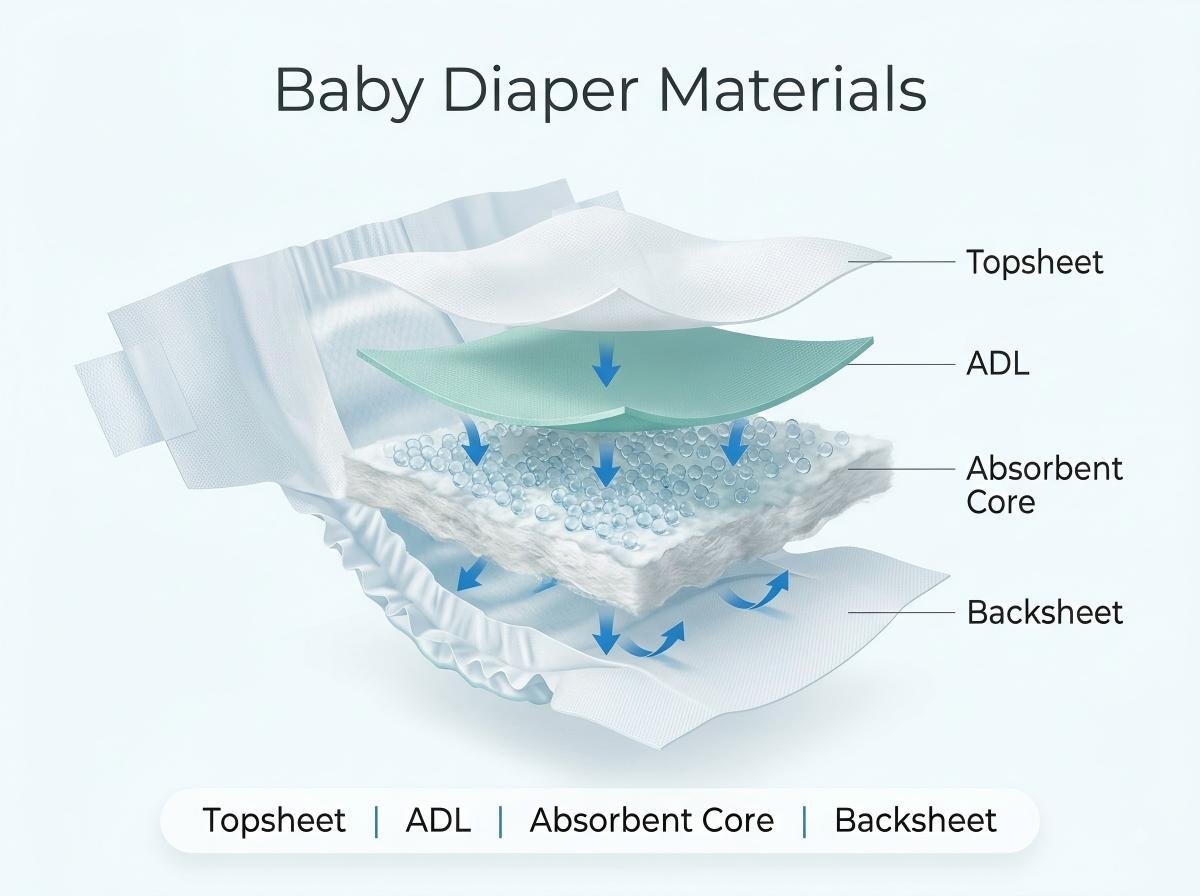
A simplified structure looks like this:
Topsheet → ADL → Absorbent Core → Backsheet
Around these layers, additional components such as leg cuffs, elastics, waistband materials, and fastening systems help provide fit, comfort, and leakage protection.
For OEM projects, the manufacturer needs to consider these materials as part of one complete diaper structure rather than selecting each component independently.
Topsheet Materials
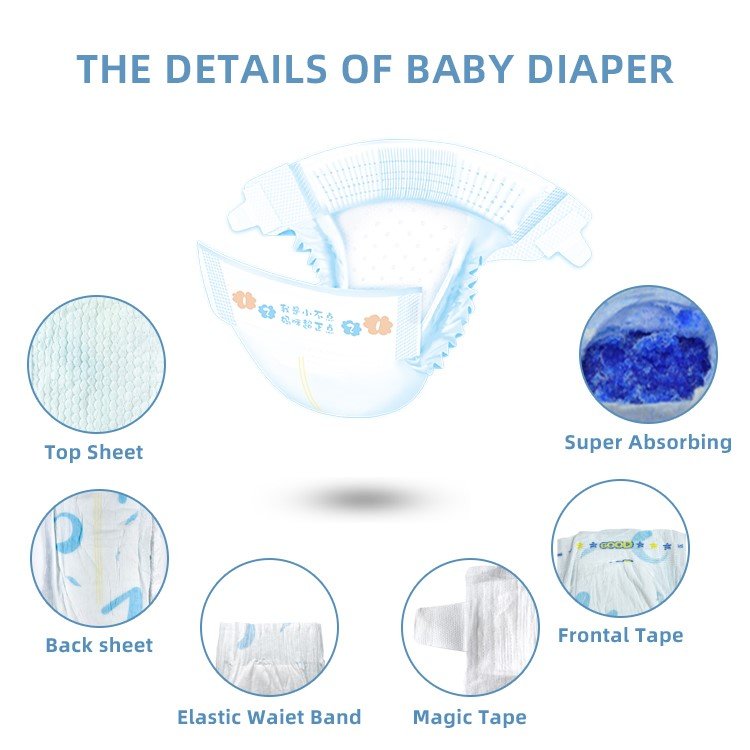
The topsheet is the layer that comes into direct contact with the baby’s skin.
Because of this, it has a major influence on the baby’s first impression of the diaper.
The topsheet needs to feel soft and comfortable while allowing liquid to pass through quickly into the absorbent structure underneath.
Common Topsheet Materials
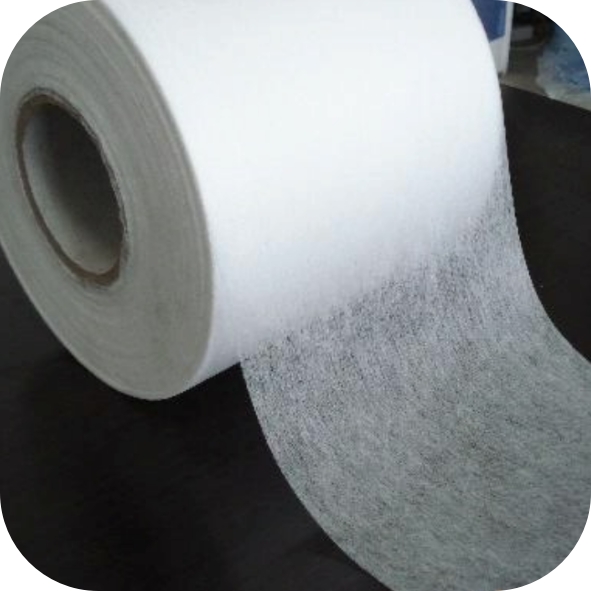
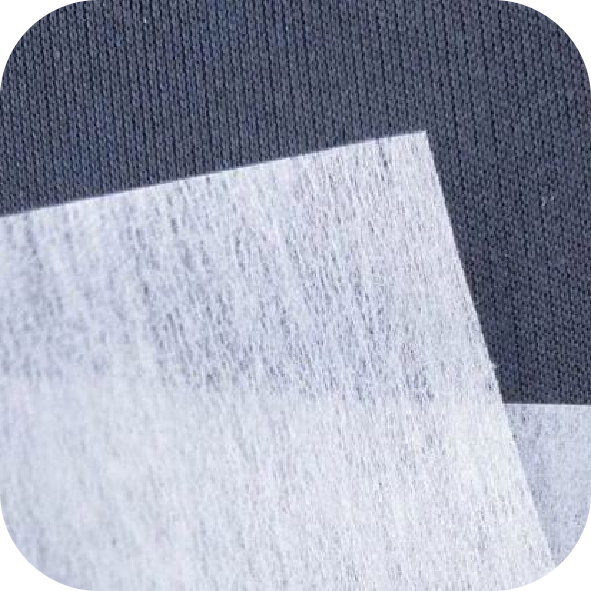
Common topsheet options used in baby diapers include:
- Spunbond non-woven fabric
- Hot air through non-woven fabric
- Bamboo viscose non-woven fabric for selected bamboo diaper designs
These materials can differ in softness, liquid acquisition, surface feel, and overall product performance. The right choice depends on the diaper structure, target market, product positioning, and cost requirements.
The exact material and treatment can vary depending on the product structure and target positioning.
What Does the Topsheet Affect?
The topsheet can influence:
- النعومة
- Skin-contact feel
- Liquid penetration
- Surface dryness
- Overall comfort
For example, a brand positioned around premium softness may prioritize a particularly soft topsheet structure.
On the other hand, a cost-focused product may use a more conventional material that still meets the required performance standards.
This is why “softest material” does not always mean “best material.” The right choice depends on the overall product design.
For brands interested in bamboo-based product positioning, you can also explore our حفاضات أطفال من الخيزران to see how bamboo viscose is incorporated into a diaper structure.
Absorbent Core Materials
The absorbent core is one of the most important parts of a baby diaper.
Its main function is to receive, distribute, and retain liquid.
The core structure can have a major impact on:
- الامتصاصية
- Retention
- الحماية من التسرب
- السُمك
- إعادة ترطيب الأداء
- Product weight
Traditional wood-pulp core diapers commonly use fluff pulp and SAP as the main absorbent materials. However, not all baby diapers use the same core structure. Ultra-thin diapers can use a full-core structure that combines high-loft nonwoven matrix and SAP with airlaid paper or non-woven wrapping materials.
Therefore, when comparing diaper materials, brand owners should look at the complete core structure rather than focusing on SAP or fluff pulp alone.
Fluff Pulp
Fluff pulp is a wood-based cellulose material used to form the absorbent structure.
It helps distribute liquid through the core and provides the structure needed to hold other absorbent materials.
The quality and characteristics of the fluff pulp can influence the overall performance of the absorbent core.
بوليمر فائق الامتصاص (SAP)
SAP is a highly absorbent polymer used to absorb and retain liquid.
When liquid reaches the absorbent core, SAP absorbs it and forms a gel that helps retain the liquid inside the diaper.
The amount and distribution of SAP need to work together with the rest of the core structure.
Using more SAP does not automatically create a better diaper. The manufacturer needs to consider SAP distribution, core design, liquid acquisition, stability, and the intended product performance.
Fluff Pulp + SAP
For a traditional wood-pulp core diaper, fluff pulp and SAP work together.
A simplified concept is:
Liquid → Acquisition → Distribution → Absorption → Retention
The goal is to move liquid away from the skin quickly and retain it inside the absorbent core.
New EcoCare uses Sumitomo SAP from Japan and fluff pulp sourced from the United States, including FSC-certified options, depending on product requirements.
For a deeper discussion of diaper raw materials and construction, you can also explore our baby diaper materials guide.


Acquisition and Distribution Layer
The acquisition and distribution layer, often referred to as an ADL, sits between the topsheet and absorbent core.
Its role is to help manage liquid after it passes through the topsheet.
Instead of allowing all the liquid to remain concentrated in one small area, the ADL helps move liquid across the absorbent structure.
This can support:
- Faster liquid acquisition
- Better liquid distribution
- Improved absorbent core utilization
- Reduced local saturation
- Better surface dryness
The ADL becomes particularly important when the diaper needs to handle repeated or larger amounts of liquid.
Why ADL Design Matters
A diaper can contain a high-performance absorbent core, but the core still needs to receive liquid efficiently.
Therefore, the topsheet, ADL, and absorbent core need to work together.
This is a good example of why brand owners should evaluate baby diaper construction as a complete system rather than judging individual materials separately.
Backsheet Materials
The backsheet forms the outer layer of the diaper.
Its main role is to help prevent liquid from leaking through the diaper while contributing to the overall feel and appearance of the product.
Common backsheet structures may include:
- فيلم PE
- غشاء خلفي قابل للتنفس
- Nonwoven composite structures
- Other multilayer backsheet constructions
What Does the Backsheet Affect?
The backsheet can influence:
- الحماية من التسرب
- قابلية التنفس
- النعومة
- Outer appearance
- Noise or “rustle” feel
- Overall diaper thickness
A breathable backsheet can allow water vapor to move through the material while still helping prevent liquid leakage.
For premium baby diapers, the manufacturer may need to balance breathability, softness, strength, and leakage protection rather than focusing on one characteristic alone.

Leg Cuffs and Elastic Components
Baby diapers need to move with the baby’s body while maintaining a secure fit.
Leg cuffs and elastic components help create this fit.
They can influence:
- Leg fit
- الحماية من التسرب
- الراحة
- Stretchability
- Overall product shape
If the leg area is too loose, leakage protection may suffer.
If it is too tight, the diaper may become uncomfortable.
Therefore, the design of elastic components needs to match the diaper size, structure, and intended fit.
For an OEM project, the manufacturer may adjust elastic placement, tension, and construction based on the product requirements.
Waistband and Fastening Components
The waistband helps the diaper fit securely around the baby’s waist.
Depending on the diaper type, the product may also use fastening components such as:
- Front tape
- Landing zone
- Hook-and-loop fastening
- Other fastening structures
For taped diapers, the fastening system needs to provide secure attachment while still allowing parents to adjust the diaper during use.
For baby pull-up pants, the construction is different because the product is designed to be pulled on and off like underwear.
This means material selection also needs to match the type of diaper being manufactured.
If you are developing a pull-up product rather than a taped diaper, you can also review our Baby Pull-Up Pants product range.
How Material Choices Affect Diaper Performance
The most important point for brand owners is that no individual material determines the entire diaper’s performance.
Instead, different materials work together.
Here is a simplified example:
| Material / Component | Main Function | Product Characteristics It Can Influence |
|---|---|---|
| الصفحة العلوية | Skin contact and liquid passage | Softness, comfort, dryness |
| ADL | Liquid acquisition and distribution | Acquisition, distribution, dryness |
| لب الزغب | Core structure and liquid distribution | Absorbency, structure |
| SAP | Liquid absorption and retention | Absorbency, retention |
| اللوح الخلفي | Outer barrier | Leakage protection, breathability |
| Leg elastics | Leg fit | Fit, comfort, leakage protection |
| Waist elastics | Waist fit | Comfort, fit |
| Fastening system | Diaper adjustment | Fit, convenience |
This is why a professional OEM manufacturer should evaluate the complete construction.
For example, if you want an ultra-thin diaper, the manufacturer may need to consider:
- Core structure
- SAP level and distribution
- Fluff pulp usage
- Acquisition layer
- الصفحة العلوية
- اللوح الخلفي
- Overall compression and construction
The objective is to reduce bulk without sacrificing the performance your target market expects.
You can learn more about this approach on our Ultra Thin Baby Diapers product page.
How to Choose Materials for Different Baby Diaper Product Positions
There is no single combination of baby diaper raw materials that works for every brand.
The right material strategy depends on the market you want to serve.
Premium Baby Diapers
A premium product may focus on:
- Very soft skin-contact materials
- Comfortable fit
- Strong absorbency
- Good leakage protection
- Breathable materials
- Premium packaging
In this case, material selection should support the overall premium consumer experience.
Value-Focused Baby Diapers
A value-focused product may prioritize:
- Reliable absorbency
- Practical leakage protection
- Stable quality
- Competitive production cost
- Efficient packaging
The goal is to achieve the required performance without adding unnecessary material costs.
Ultra-Thin Baby Diapers
Ultra-thin diapers focus on reducing bulk while maintaining the absorbency and leakage protection expected from a modern baby diaper.
Unlike traditional wood-pulp core diapers, an ultra-thin diaper can use a full-core structure that directly combines absorbent materials such as high-loft nonwoven matrix and SAP within the core system. The absorbent core can be wrapped with airlaid paper or non-woven material to form a compact structure.
When developing an ultra-thin product, the manufacturer may need to optimize:
- Full-core structure
- SAP distribution
- Airlaid paper
- ADL
- الصفحة العلوية
- اللوح الخلفي
The goal is to reduce overall bulk while maintaining sufficient absorbency, liquid acquisition, comfort, and leakage protection.
This type of construction requires the manufacturer to balance several materials and structural factors at the same time. A thinner diaper is not simply a matter of removing material; the absorbent core needs to maintain its performance while achieving a more compact structure.
What to discuss with your OEM manufacturer:
Ask how the full-core structure affects absorbency, thickness, SAP distribution, and production feasibility before approving the sample.
حفاضات أطفال من الخيزران
Bamboo baby diapers can support a more sustainability-focused product position.
For example, bamboo viscose can be used in selected components of the diaper construction.
However, brand owners should not assume that using one bamboo-based component automatically makes the entire diaper biodegradable or plastic-free.
The overall product construction and material composition need to be evaluated carefully.
At New EcoCare, our bamboo baby diapers use bamboo viscose in the topsheet and backsheet, with a structure designed around the product’s intended performance and sustainability positioning.
Questions Brand Owners Should Ask Their OEM Manufacturer
Before finalizing your product, it is useful to ask your OEM manufacturer specific questions about the materials and construction.
1. What materials do you recommend for my target market?
The answer should relate to your product positioning, consumer expectations, and budget.
2. What is the absorbent core structure?
Ask about the use of:
- لب الزغب
- SAP
- Core construction
- SAP distribution
- Other absorbent components
3. What materials are used for the topsheet and backsheet?
You should understand how these materials affect softness, liquid acquisition, leakage protection, and breathability.
4. Can the materials be customized?
Different OEM manufacturers offer different levels of customization.
Ask which materials, structures, and components can be adjusted for your project.
5. How do material changes affect cost?
A material upgrade may improve one product characteristic but also increase production cost.
Your manufacturer should help you understand the trade-off.
6. Can you provide samples with different material combinations?
Comparing samples can help you evaluate differences in softness, thickness, absorbency, and overall feel before mass production.
7. What quality control is performed on incoming materials?
Material quality is the foundation of finished-product quality.
Ask how the manufacturer checks and approves incoming raw materials before they enter production.
For more information about how materials fit into the broader manufacturing process, see our Materials & Technology section within our OEM Manufacturing resources.
How Material Selection Fits Into the OEM Manufacturing Process
Material selection is only one part of the complete OEM development process.
A typical project may follow this sequence:
Product Requirements → Material & Structure Selection → Sample Development → Sample Approval → Production Preparation → Manufacturing → Quality Control → Packaging → Shipment
Each stage connects with the next.
For example, changing the absorbent core may affect the diaper thickness. Changing the thickness may affect the overall product structure. A structural change may then affect packaging dimensions or production settings.
That is why material decisions should be made together with the manufacturer rather than treated as an isolated purchasing decision.
If you want to understand the complete manufacturing workflow, see our OEM Manufacturing resources and our guide to the حفاضات الأطفال الأصلية manufacturing process.
الأفكار النهائية
Understanding baby diaper materials gives brand owners a much better starting point when developing a private label product.
A diaper is not simply a combination of soft fabric and absorbent material. Its performance comes from how the topsheet, ADL, absorbent core, SAP, fluff pulp, backsheet, elastic components, and other materials work together.
The best material choice depends on your:
- Target market
- Product positioning
- Performance requirements
- Consumer expectations
- Target price
- Production volume
- Brand strategy
For this reason, the goal should not be to find the “best” material in isolation.
The goal is to develop the right combination of materials and construction for your product.
An experienced OEM manufacturer can help you compare material options, develop samples, adjust the product structure, and find the right balance between performance, comfort, cost, and brand positioning.
If you are planning a new private label baby diaper brand, start with your target market and product concept. Then work with your OEM partner to turn those requirements into a practical diaper structure and material specification.
That approach can help you build a product that is not only suitable for production, but also makes sense for your customers and your long-term brand strategy.

 Arabic
  English
  Spanish
  Russian
  German
  French
  Italian
  Portuguese
  Greek
Greek