
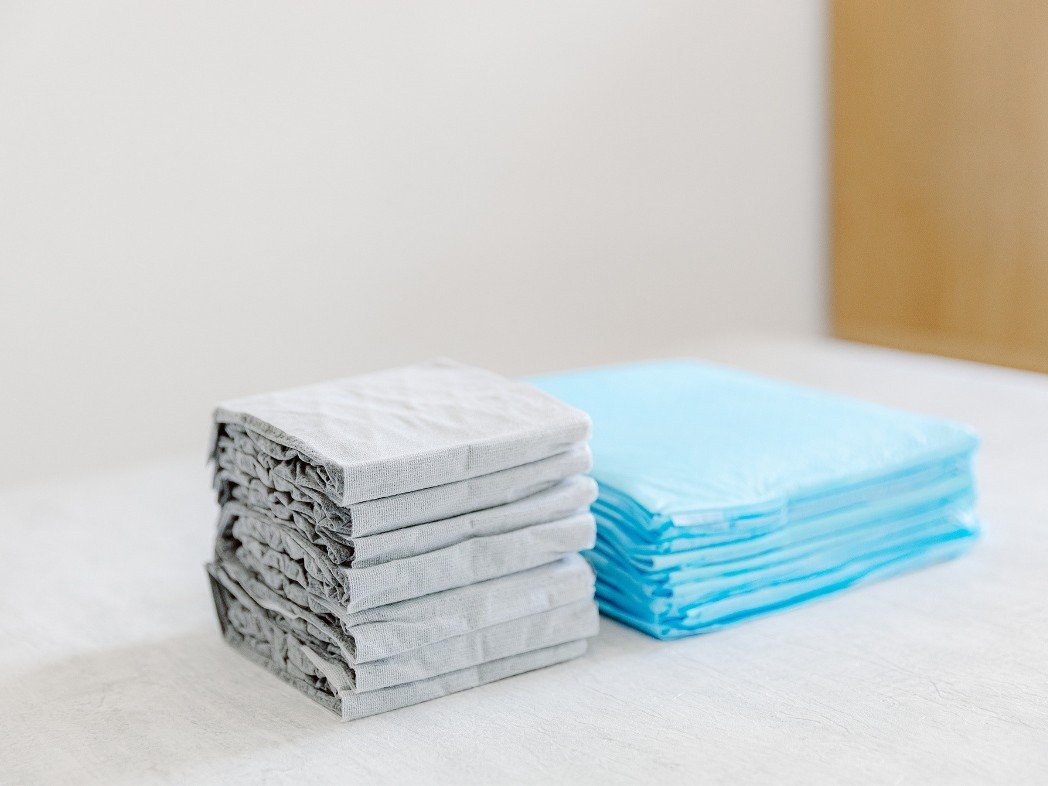
When building an adult incontinence product range, brands often start with one question: Which products should we offer first?
Adult diapers are usually the main product because they provide wearable protection for people managing urinary or fecal incontinence. Incontinence underpads serve a different purpose. They help protect beds, chairs, and other surfaces from moisture.
Although these products address the same broader care challenge, they are not interchangeable. They support different routines, purchasing needs, and care environments.
For brand owners, importers, wholesalers, and senior-care suppliers, the decision is not simply about choosing between adult diapers and underpads. It is about understanding when each product makes sense, whether both belong in the same portfolio, and how to build a range that meets market demand without creating unnecessary inventory complexity.
At New EcoCare, we work with B2B customers on OEM and private label hygiene products. In this article, we explain how to evaluate adult diapers and incontinence underpads from a product-range perspective.
جدول المحتويات
1. Why Product Range Planning Matters in Adult Incontinence
Adult incontinence products serve people with different mobility levels, care routines, and protection needs. A product that works well for one user may not be suitable for another.
For distributors and wholesalers, offering only one product type can limit the customers they serve. A retailer may need wearable products for everyday use, while a nursing home may also need disposable pads to protect mattresses and seating.
However, launching too many products at once creates other challenges. Each additional SKU may require its own specifications, packaging, inventory, quality checks, and sales forecasts.
The goal is to build a product range that covers the most relevant needs without making purchasing and stock management unnecessarily complicated.
Before expanding your range, consider three questions:
Who are your main customers? Retailers, pharmacies, medical distributors, home-care suppliers, and institutional buyers may have different requirements.
What problems do they need to solve? Wearable incontinence protection and surface protection are related but distinct needs.
How much variety can your business support? Product sizes, absorbency levels, pack quantities, and packaging formats all affect SKU complexity.
Understanding these factors helps you decide whether to start with adult diapers, add underpads, or develop both categories together.
2. What Are Adult Diapers Designed For?
Adult diapers are wearable absorbent products designed to manage urinary incontinence and, depending on the product and its intended use, fecal incontinence.
They are commonly used at home, in senior-care facilities, in healthcare settings, and by people who need protection during daily activities or overnight.
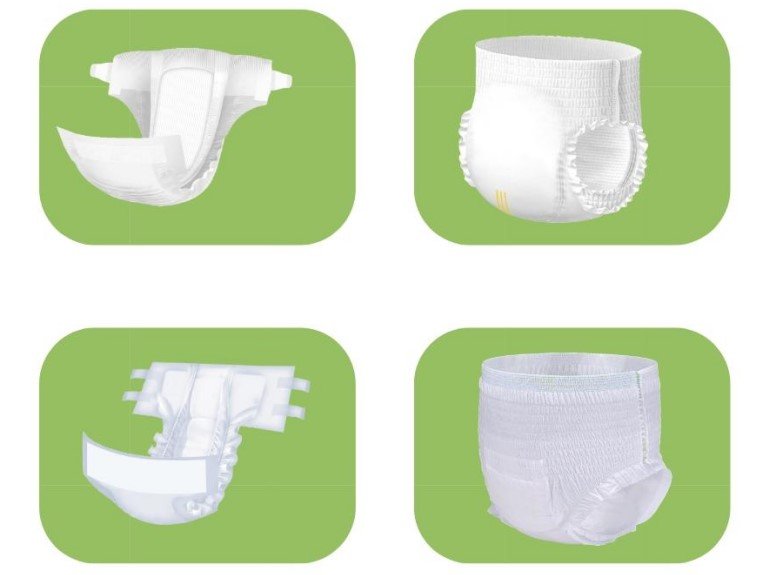
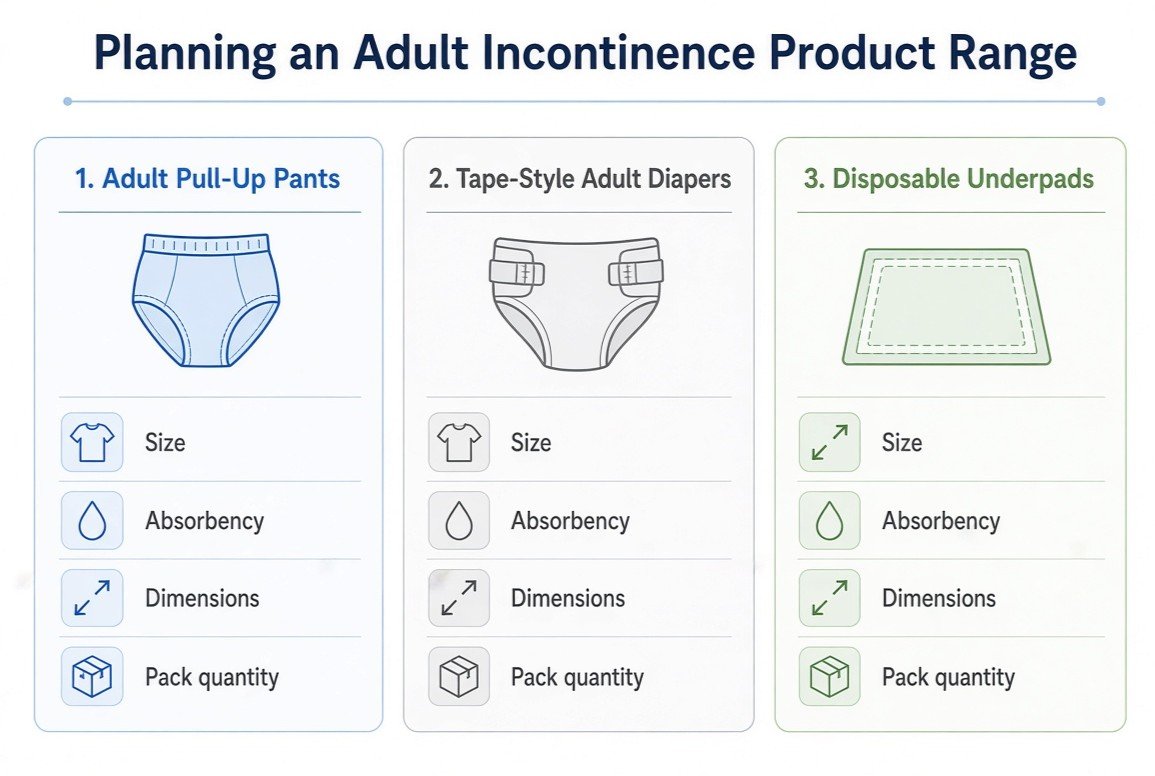
Two common formats are pull-up pants and tape-style adult diapers.
Pull-up pants resemble underwear and are generally suitable for users who can stand or move sufficiently to put them on, or who prefer a more underwear-like design. Tape-style diapers have adjustable fastening tabs and can be more practical for users who need assistance with changing, including some people with limited mobility or who receive care in bed.
When planning an adult diaper range, brands should evaluate several factors:
Product format: Pull-up pants, tape-style diapers, or both.
Size range: Sizes should correspond to the intended market and the manufacturer’s available specifications.
Absorbency performance: Match the product to expected use, leakage protection requirements, and changing routines.
Fit and comfort: Waist fit, leg openings, fastening systems, and material softness can affect product acceptance.
التعبئة والتغليف: Pack count, bag design, labeling, and carton configuration should suit the sales channel.
A product range does not need to include every possible size and absorbency level from day one. A more practical approach is to identify the formats and sizes most likely to meet the needs of your target buyers, then expand based on sales data.
For a closer look at product formats, read Adult Pull-Up Diapers vs. Taped Diapers: Which to Offer in Your Product Line?.
3. What Are Incontinence Underpads Designed For?
Incontinence underpads are absorbent pads placed on beds, chairs, wheelchairs, examination surfaces, or other areas that need protection from moisture.
They are often used alongside adult diapers rather than as a direct replacement for them.
For example, a caregiver may use an adult diaper to manage incontinence during daily activities and place an underpad on the bed to provide an additional layer of surface protection. A healthcare facility may also use underpads during personal care or when changing a patient.
Disposable underpads generally consist of an absorbent core, a fluid-permeable top layer, and a backing designed to help protect the underlying surface. Their dimensions, absorbency, core construction, and backing materials vary by product.
When evaluating underpads for a private label range, consider:
Dimensions: The pad should cover the intended area adequately.
الامتصاصية: Requirements differ between light surface protection and more demanding care situations.
Backsheet performance: The backing should provide suitable protection against fluid passing through to the surface below.
Surface and core construction: These influence fluid acquisition, distribution, and retention.
Packaging and quantity: Pack sizes should reflect the needs of retail customers or institutional purchasers.
Underpads are also used outside residential elder care, including some healthcare and personal-care environments. Their suitability depends on the intended application and product specifications.
For brands, underpads can create an additional product category without requiring customers to replace their existing wearable protection products.

4. Adult Diaper vs. Incontinence Underpad: Key Differences
The main difference is what each product protects and how it is used.
| Comparison point | حفاضات للكبار | Incontinence underpads |
|---|---|---|
| Primary purpose | Wearable incontinence management | Protection for beds, chairs, and other surfaces |
| Where used | Worn on the body | Placed on a surface |
| Common formats | Pull-up pants and tape-style diapers | Disposable rectangular pads in different sizes |
| Main selection factors | Fit, size, absorbency, leakage protection, and comfort | Dimensions, absorbency, core construction, and backing |
| Typical buyers | Retailers, pharmacies, home-care suppliers, and care facilities | Retailers, medical distributors, senior-care suppliers, and institutions |
| Product-range role | Core wearable protection category | Complementary surface-protection category |
These differences matter when you plan product specifications and sales channels.
Adult diapers require particular attention to body fit and leakage protection. Underpads need to cover the intended surface and retain fluid effectively. Both categories require appropriate performance testing, but the evaluation criteria are not identical.
It is also important not to assume that an underpad can replace an adult diaper. Underpads protect surfaces, but they do not provide the same wearable protection during movement. Likewise, an adult diaper does not eliminate the potential need for additional bed or chair protection.
For more on absorbency selection, see لماذا لا تكون زيادة الامتصاصية أفضل دائمًا عند اختيار حفاضات البالغين.
5. When Should a Brand Offer Adult Diapers?
Adult diapers are generally the logical starting point if your business focuses on wearable incontinence care.
Consider prioritizing them when:
Your customers are retailers, pharmacies, or adult incontinence product distributors.
Your target market has demand for daily or overnight wearable protection.
You want to serve both users who can change independently and those who need caregiver assistance.
You have identified suitable size, format, and absorbency requirements.
Your sales channels can support the inventory and replenishment needs of wearable products.
For a new private label brand, it may be more manageable to begin with a limited selection of high-priority sizes and one or two formats, depending on market demand and minimum order requirements.
For example, a brand serving independent users might initially focus on pull-up pants. A supplier serving care facilities may need to evaluate tape-style diapers as well, especially where caregivers assist with changing.
These are starting points, not universal rules. Local preferences, purchasing budgets, existing competitors, and care practices should guide the final assortment.
Before committing to large production volumes, validate the product samples, fit, absorbency performance, packaging, and commercial terms with your manufacturer.
6. When Should a Brand Add Underpads?
Underpads become particularly relevant when your customers also need protection for beds, chairs, or other surfaces.
You may want to add them when:
Your existing customers ask for complementary incontinence products.
You supply senior-care facilities, home-care businesses, or medical distributors.
Your sales team wants to offer a broader range to existing accounts.
You can identify demand for particular dimensions, absorbency levels, and pack quantities.
Your purchasing and warehouse operations can accommodate another product category.
One advantage of underpads is that they address a different use case from adult diapers. This creates an opportunity to serve more of a customer’s purchasing needs without relying entirely on additional diaper formats or absorbency variants.
However, underpads are not automatically a profitable addition. Demand, competitive pricing, product quality, shipping costs, packaging, and minimum order quantities all influence their commercial value.
A good starting point is to ask existing customers whether they currently buy underpads, which specifications they prefer, and whether they would consider sourcing them from the same supplier as their adult diapers.
That feedback is more useful than adding several underpad SKUs simply to make the catalog look larger.
7. Should You Sell Both Products?
For many B2B suppliers, offering adult diapers and underpads together is worth evaluating because the products address complementary needs.
The strongest opportunity often comes from serving the same customer more completely.
For example, a senior-care distributor may purchase wearable products for residents and underpads for beds and chairs. A home-care supplier may want both categories to offer caregivers a more complete selection. A wholesaler may find that adding underpads creates an opportunity to increase the range available to existing retail accounts.
A combined range may also simplify supplier management if the manufacturer can meet the required specifications and production needs for both categories.
Still, there is no need to launch everything simultaneously.
A phased approach can reduce risk:
Start with your main category. Build a clear offer around the product with the strongest confirmed demand.
Validate complementary demand. Ask existing buyers whether underpads would solve a current purchasing need.
Test the commercial fit. Compare minimum order quantities, landed costs, expected selling prices, and inventory requirements.
Expand selectively. Add the most relevant underpad specification rather than several variations at once.
Review actual sales. Use reorder frequency, customer feedback, and stock turnover to decide whether to broaden the range.
The right combination depends on your customer base and business model. A retailer-focused brand and an institutional supplier may need different product mixes.
8. How to Build a Practical Adult Incontinence SKU Range
A useful product range should be easy for customers to understand and manageable for your purchasing team.
Instead of starting with a long list of possible SKUs, build the range in stages.
Stage 1: Define the main customer group.
Decide whether you primarily serve retail, wholesale, medical distribution, or institutional care. This helps establish the product formats, packaging, and specifications worth prioritizing.
Stage 2: Select the core wearable format.
Determine whether pull-up pants, tape-style diapers, or both are needed. Confirm the target sizes and performance requirements before finalizing the assortment.
Stage 3: Evaluate underpads as a complementary category.
Identify the surface-protection needs of your customers. Select dimensions, absorbency requirements, and pack quantities based on actual applications rather than offering every available option.
Stage 4: Check the commercial requirements.
Ask your manufacturer to confirm minimum order quantities, size-level ordering requirements, packaging options, lead times, and sample availability. Do not assume that different sizes or product types can always be combined under one minimum order.
Stage 5: Calculate the cost of the complete range.
Consider product cost, packaging, freight, storage, and expected inventory turnover. A broader range can increase sales opportunities, but it can also tie up working capital if demand is uncertain.
Stage 6: Establish a review point.
After launch, review sales by SKU, reorder frequency, customer feedback, and stock movement. Use the results to decide which products deserve expansion and which should remain limited.
A practical range is not necessarily the largest one. It is the range that matches customer needs while remaining commercially sustainable.
9. What Should You Discuss With Your OEM Manufacturer?
Once you have identified the products your market needs, the next step is to confirm whether the proposed range is practical to manufacture and purchase.
At New EcoCare, we recommend discussing the following points before finalizing a private label order.
Product specifications: Confirm formats, sizes, dimensions, core construction, absorbency targets, backing materials, and other performance requirements. Make sure the specifications are documented for each SKU.
Samples and testing: Review samples before mass production. Evaluate fit and usability for adult diapers, and fluid handling and surface protection for underpads. Agree on appropriate acceptance criteria rather than relying on general descriptions such as “high absorbency.”
MOQ and order structure: Confirm the minimum order quantity for each product and size. Ask whether different SKUs can be combined in one order and how this affects production planning.
Packaging and labeling: Discuss pack counts, artwork, barcode requirements, carton specifications, and market-specific labeling needs. Confirm responsibilities for artwork approval and final production files.
Quality control: Establish how product specifications will be checked, how samples will be approved, and how quality issues will be handled. Requirements should be clear before production starts.
Lead times and repeat orders: Understand the expected production schedule, material availability, and arrangements for repeat orders. This is particularly important if you plan to launch several products or supply customers on recurring schedules.
For brands developing a broader adult incontinence portfolio, a manufacturer with experience in both wearable products and underpads can help coordinate product development and purchasing discussions.
You can learn more about New EcoCare’s adult diaper manufacturing capabilities or explore adult diaper customization for private label projects.
10. Final Product-Range Checklist
Before launching or expanding your adult incontinence range, check that you can answer these questions:
Have we identified our main customer groups and their actual purchasing needs?
Do we understand the different roles of adult diapers and underpads?
Have we selected the right diaper formats, sizes, and performance specifications?
Have we confirmed the required underpad dimensions and absorbency targets, if applicable?
Have we validated demand before adding too many SKUs?
Have we confirmed MOQs, packaging requirements, lead times, and sample approval procedures?
Have we evaluated inventory costs and expected reorder frequency?
Do we have a clear plan for reviewing product performance and expanding the range?
If several answers are still uncertain, it may be better to validate the core products first instead of launching a large assortment immediately.
الأفكار النهائية
Adult diapers and incontinence underpads serve different but complementary roles. Adult diapers provide wearable protection, while underpads help protect beds, chairs, and other surfaces.
For brands, distributors, and wholesalers, the decision should come down to customer needs, product performance, commercial feasibility, and the ability to manage the resulting SKUs.
At New EcoCare, we support B2B customers developing OEM and private label hygiene products. By defining your target market and product specifications before production, you can build an adult incontinence range that is practical to source, easier to manage, and better aligned with your customers’ needs.
If you are planning to develop or expand your adult incontinence product range, contact New EcoCare to discuss your product requirements and OEM options.

 Arabic
 English
 Spanish
 Russian
 German
 French
 Italian
 Portuguese
 Greek