

When building an adult incontinence product line, choosing sizes is only one part of the decision. For distributors, wholesalers, importers, and brand owners, the bigger question is how many sizes and product configurations the market actually needs.
A well-planned adult diaper size range should balance customer coverage with SKU management, inventory, production requirements, and product positioning.
At New EcoCare, we work with B2B customers to develop adult incontinence products based on their target market, product positioning, and order requirements. This gives us a practical view of the decisions buyers need to make before launching or expanding an adult diaper range.
If you are building an adult incontinence product line, start by reviewing the Adult Incontinence Knowledge Center for information on product types, materials, manufacturing, OEM, and product selection.
Índice
1. Why Product Range Planning Matters for Adult Diaper Brands
A larger product range is not automatically a better product range.
Every additional size, product type, absorbency level, or packaging configuration can create another SKU to forecast, purchase, store, and replenish.
At the same time, offering too few options may leave important customer groups without a suitable product.
A good adult diaper product line should therefore be:
- Broad enough to cover the main customer groups
- Simple enough for customers to understand
- Manageable for inventory
- Practical for production
- Flexible enough to expand later
For example, a new brand may not need five sizes and three product types at launch. A smaller core range can be easier to test first, with additional sizes introduced when actual sales data shows demand.
The right range depends on the market—not simply on what a manufacturer can produce.
2. Understanding Adult Diaper Sizing
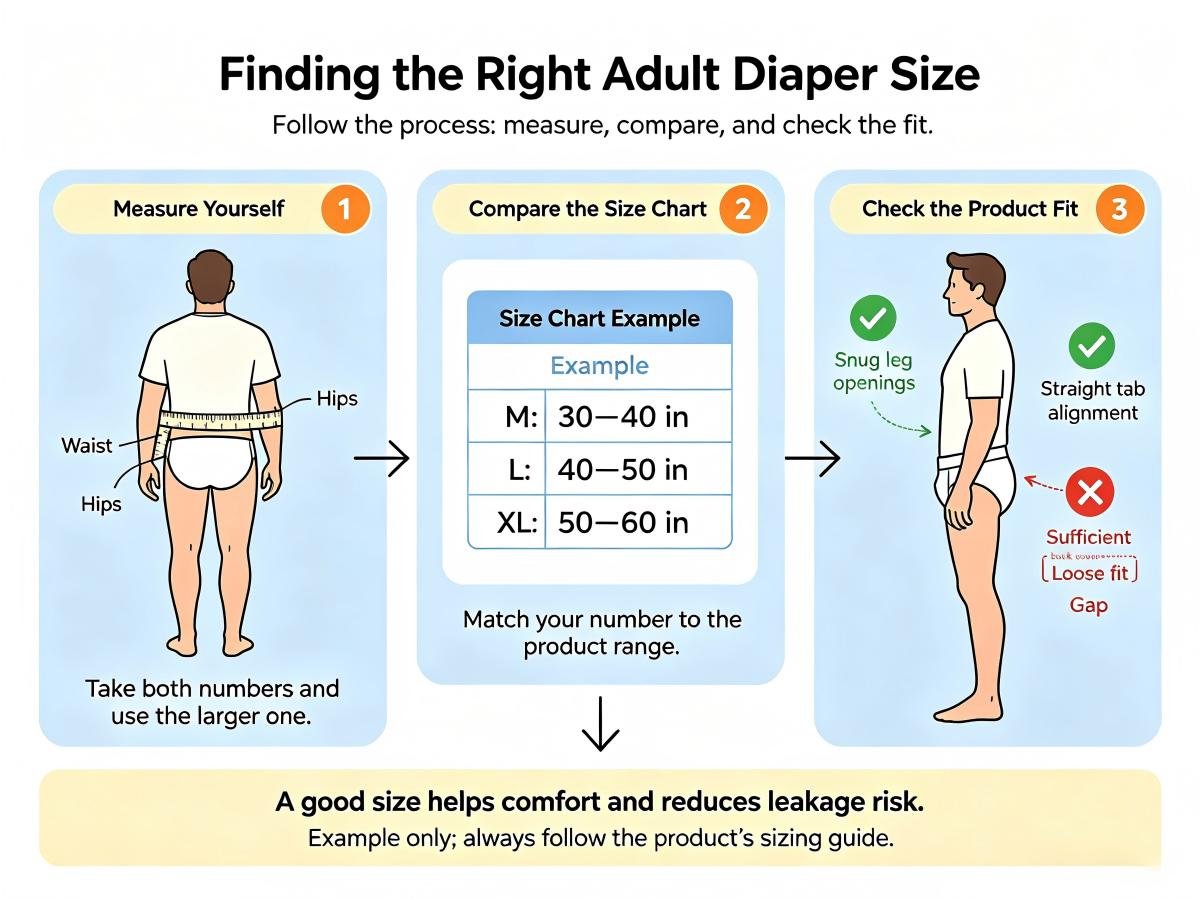
Adult diaper sizing is normally based on body measurements rather than age. Depending on the product, waist or hip measurements may be used as the main reference.
This is important for B2B buyers because size labels are not necessarily standardized across manufacturers.
An M-size product from one supplier may have different dimensions or a different recommended measurement range from an M-size product from another supplier.
When developing your range, ask your OEM manufacturer for:
- Available sizes
- Waist or hip measurement ranges
- Finished product dimensions
- Size-specific specifications
- Product samples for fit evaluation
Do not build your entire range based only on labels such as M, L, XL, or XXL.
The actual measurement range and product construction are more useful when comparing suppliers.
What About an Adult Diaper Size Chart?
An adult diaper size chart is useful, but it should be treated as a manufacturer-specific reference rather than a universal standard.
For private label products, the size information printed on your packaging should match the final product specifications agreed with your OEM manufacturer.
This helps keep product information consistent across samples, packaging, production, and future repeat orders.
3. How to Build a Practical Size Range
A practical adult diaper size range usually starts with the sizes most relevant to the target market.
For example, a brand may choose M, L, XL, and XXL as its initial core range, then consider XXXL when there is enough demand for extended sizing.
At New EcoCare, our adult incontinence products are available in sizes from M to XXXL, depending on the product specification. This gives B2B buyers room to consider both core and extended sizes when developing a private label range.
A useful approach is to divide your planned sizes into three groups.
Core Sizes
These are the sizes expected to generate the most demand.
They should receive the highest inventory priority because stock availability matters most for your main-selling SKUs.
Extended Sizes
These sizes serve customers outside your main volume segment.
They may have lower turnover, but they can make your product range more inclusive and reduce the risk of losing customers whose measurements fall outside your core range.
Planned-Order Sizes
Some sizes may not need to be kept in regular stock.
If demand is limited but there is still a clear market requirement, you can discuss producing these sizes based on confirmed orders.
This approach can help reduce unnecessary inventory while maintaining a wider overall range.
4. Should Every Brand Offer Every Size?
Not necessarily.
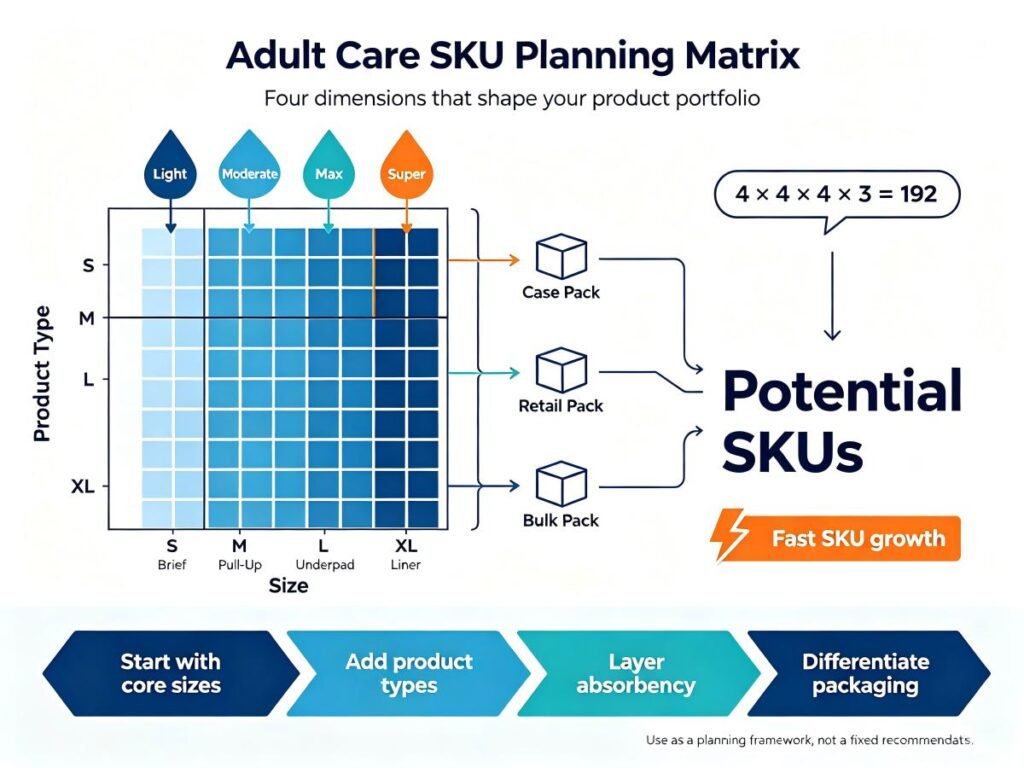
One of the easiest ways to make an adult diaper product line complicated is to add every possible size and configuration from the beginning.
Consider a simple example:
- 5 sizes
- 2 product types
- 2 absorbency levels
- 2 package configurations
That creates up to 40 SKU combinations.
You may not need all of them.
Before adding a new SKU, ask:
Does this product serve a different customer need, or does it simply create another variation?
For a new brand, a focused range may be easier to manage.
For an established distributor with sales data across different customer groups, a wider range may make more commercial sense.
The important thing is to connect each SKU to a clear market requirement.
5. Matching Sizes With Target Customer Segments
Your target customer should influence your size strategy.
Retail and E-Commerce
Consumer-facing channels benefit from simple size communication.
Customers should be able to understand the size range quickly from the package or online product page.
Clear measurement information is particularly important because buyers cannot physically try the product before purchase.
Pharmacy and Home-Care Distribution
These channels may require a broader practical range because customers have different body sizes and care requirements.
Reliable size specifications can also make it easier for sales teams to recommend the appropriate product.
Senior-Care and Institutional Buyers
Institutional buyers may purchase larger quantities and may have a different SKU structure from retail customers.
For example, a nursing-care customer may prioritize a dependable supply of several commonly used sizes rather than a very large consumer-facing assortment.
Importers and Wholesalers
Wholesalers need to consider not only market demand but also inventory and order quantities.
A size that sells slowly may still be useful, but the buyer should understand whether it should be stocked regularly or ordered according to demand.
6. How Product Type Affects Your SKU Structure
Size is only one part of your product architecture.
When building an adult incontinence product range, also consider:
- Product format
- Nível de absorção
- Day or night positioning
- Formato da embalagem
- Target user group
- Retail or institutional channel
For example, four sizes across two product formats already create eight SKUs before adding different absorbency levels or package configurations.
This is why product range planning should happen before packaging design and mass production.
At New EcoCare, we discuss the product structure with B2B customers before production so the requested specifications can be reviewed together with manufacturing requirements.
For brands developing a customized range, you can also review our Personalização de fraldas para adultos page to see the types of product requirements that can be discussed during OEM development.
7. Pull-Up Pants vs. Taped Diapers in a Product Portfolio
Pull-up pants and taped diapers should not necessarily have identical product ranges.
Pull-up pants are designed with an underwear-like structure and are often suitable for users who can pull the product on themselves.
Taped diapers use adjustable fastening and can be more practical when a caregiver is involved in changing.
This difference can affect how you structure your product line.
Por exemplo:
- A retail-focused brand may put more emphasis on pull-up pants.
- A senior-care supplier may need stronger coverage in taped diapers.
- A distributor serving both retail and care institutions may choose to offer both.
However, offering both formats does not mean every size or absorbency level needs to be duplicated across both product types.
The best structure depends on your customers and sales channels.
For a detailed comparison, please read Adult Pull-Up Diapers vs. Taped Diapers: Which to Offer in Your Product Line.
You can also review New EcoCare’s actual product options, including Fraldas para adultos e Fraldas pull-up para adultos.
8. Balancing Product Variety With Inventory Complexity
The goal is not to build the biggest possible product line.
The goal is to build a range that sells consistently and can be supplied efficiently.
Before adding a new size or product variation, review:
- Sales volume by size
- Repeat-order frequency
- Customer requests
- QUANTIDADE MÁXIMA DE ENCOMENDA
- Package quantities
- Warehouse capacity
- Production scheduling
- Expected inventory turnover
For example, if XL and XXL generate regular repeat orders while XXXL is requested only occasionally, you may choose to keep XL and XXL as core inventory while producing XXXL based on confirmed demand.
This does not mean that XXXL is unimportant. It simply gives the SKU a different inventory strategy.
The same principle can apply to product formats and absorbency levels.
A distributor can also build a broader adult incontinence product portfolio by combining adult diapers with other incontinence products instead of creating too many variations of the same diaper.
For more ideas on portfolio planning, please read our article How Adult Diaper Distributors Can Build a Profitable Incontinence Pants Wholesale Product Portfolio.
9. What to Discuss With Your OEM Manufacturer
Once you have a preliminary product range, discuss the complete plan with your OEM manufacturer before finalizing the order.
At New EcoCare, we review adult diaper projects with B2B customers based on their target specifications, including product type, size range, absorbency requirements, packaging, and production needs.
The discussion should cover:
- Which sizes are available
- Size-specific product dimensions
- Waist or hip measurement references
- Product formats
- Absorbency requirements
- Packaging specifications
- MOQ by product and size
- Sample development
- Quality requirements
- Production scheduling
The purpose is not simply to confirm whether a factory can make one sample.
You need to know whether the whole product range can be produced consistently and supplied according to your business plan.
For buyers evaluating an Fabricante de fraldas para adultos, see https://newecocare.com/adult-diaper-manufacturer/.
If your range is focused on pull-up pants, you can also review Fábrica de calças pull-up para adultos for more information.
At New EcoCare, our role is not only to manufacture the finished product. We also work with buyers through product specifications, sample development, production coordination, quality control, packaging, and shipment arrangements.

10. Adult Diaper Product Range Planning Checklist
Before approving your adult diaper product line, review these questions.
Market
- Which customer segments are we targeting?
- Which sizes are most likely to generate repeat demand?
- Do we need extended sizes for our market?
Produto
- Do we need pull-up pants, taped diapers, or both?
- Does each absorbency level have a clear purpose?
- Are the differences between SKUs easy for customers to understand?
Sizing
- Are the size labels consistent?
- Do we have the manufacturer’s actual measurement ranges?
- Have we checked samples rather than relying only on size labels?
Inventory
- Can we manage the planned number of SKUs?
- Do MOQ and package quantities match our expected order volume?
- Which sizes should be stocked and which can be produced according to demand?
OEM
- Can the manufacturer support the complete range?
- Can specifications remain consistent between sizes and production batches?
- Can the range be expanded later if market demand changes?
Perguntas mais frequentes
What should buyers look at when comparing adult diaper sizes?
Look at the actual waist or hip measurement range and finished product dimensions provided by the manufacturer. The M, L, XL, or XXL label alone is not enough to compare products from different suppliers.
Is a wider adult diaper size range always better?
No. A wider range can improve market coverage, but it also increases SKU and inventory complexity. The best range is the one that matches your actual target market and sales potential.
Should every adult diaper brand offer M to XXXL?
Not necessarily. Some markets may have stronger demand for certain core sizes, while others may require broader coverage. Buyers should use market data and customer feedback to determine the right range.
Should pull-up pants and taped diapers use the same sizes?
Not necessarily. They have different constructions and use situations, so each product format should be reviewed separately when planning the product line.
When should a brand add another adult diaper size?
Consider adding a size when customer requests, sales data, institutional requirements, or market expansion creates a clear reason to do so. An extended size can also be managed as a planned-order SKU instead of being permanently stocked.
Considerações finais
Building the right adult diaper size range is a product-planning decision, not simply a sizing decision.
Start with your target market. Identify the customer groups you need to serve, select your core sizes, and then decide which product formats and absorbency levels are actually necessary.
From there, work with your OEM manufacturer to check product specifications, MOQ, packaging, production feasibility, and long-term supply.
At New EcoCare, we believe a strong adult incontinence product line should be built around the buyer’s market—not around the number of SKUs a factory can list.
A focused, well-structured range can be easier to sell, easier to manage, and easier to scale when demand grows.

 Portuguese
  English
  Spanish
  Russian
  Arabic
  German
  French
  Italian
  Greek
Greek