For a feminine care brand, choosing between sanitary pads and period pants is not simply a product decision. It can affect your target customer, SKU structure, packaging, pricing, distribution strategy, and manufacturing requirements.
Both products can serve menstrual care needs, but they are built around different usage experiences.
Sanitary pads are familiar, versatile, and available in many formats, absorbency levels, lengths, and packaging options. Period pants offer a different wearing experience, with a pants-style structure designed to provide wider coverage and a more secure fit.
For private label brands, the better question is therefore not “Which product is better?” but:
Which product fits your brand, target market, and planned product range?
At New EcoCare, we work with B2B customers developing feminine hygiene products for different markets. This article explains the main commercial and manufacturing factors to consider when comparing sanitary pads vs period pants.
Оглавление
1. Why This Decision Matters for a Feminine Care Brand
When launching a new feminine care product, it is easy to focus first on the product itself.
However, private label buyers also need to think about what happens after manufacturing.
A product has to fit your:
- Target customer
- Retail or distribution channel
- Price positioning
- Формат упаковки
- SKU strategy
- Expected order volume
- Storage and logistics
- Product development budget
- Long-term brand portfolio
Sanitary pads and period pants can both be customized through OEM manufacturing, but the customization process is not identical.
For example, a sanitary pad range may be built around different lengths, absorbency levels, surface materials, wing structures, and pack counts. Period pants require more attention to size, hip measurements, waistband construction, leg openings, absorbency, and overall fit.
This means your initial product choice can influence the complexity of the entire product line.
If you are still defining your feminine care portfolio, the New EcoCare Feminine Care Knowledge Center provides additional information about sanitary pads, period pants, materials, manufacturing, quality, and OEM customization.
2. Sanitary Pads: Product Characteristics and Brand Opportunities
Sanitary pads remain a flexible product category for private label brands because the basic product format can be developed into different product positions.
A brand can create different SKUs for daytime use, overnight use, heavier flow, different pad lengths, or specific material positioning.
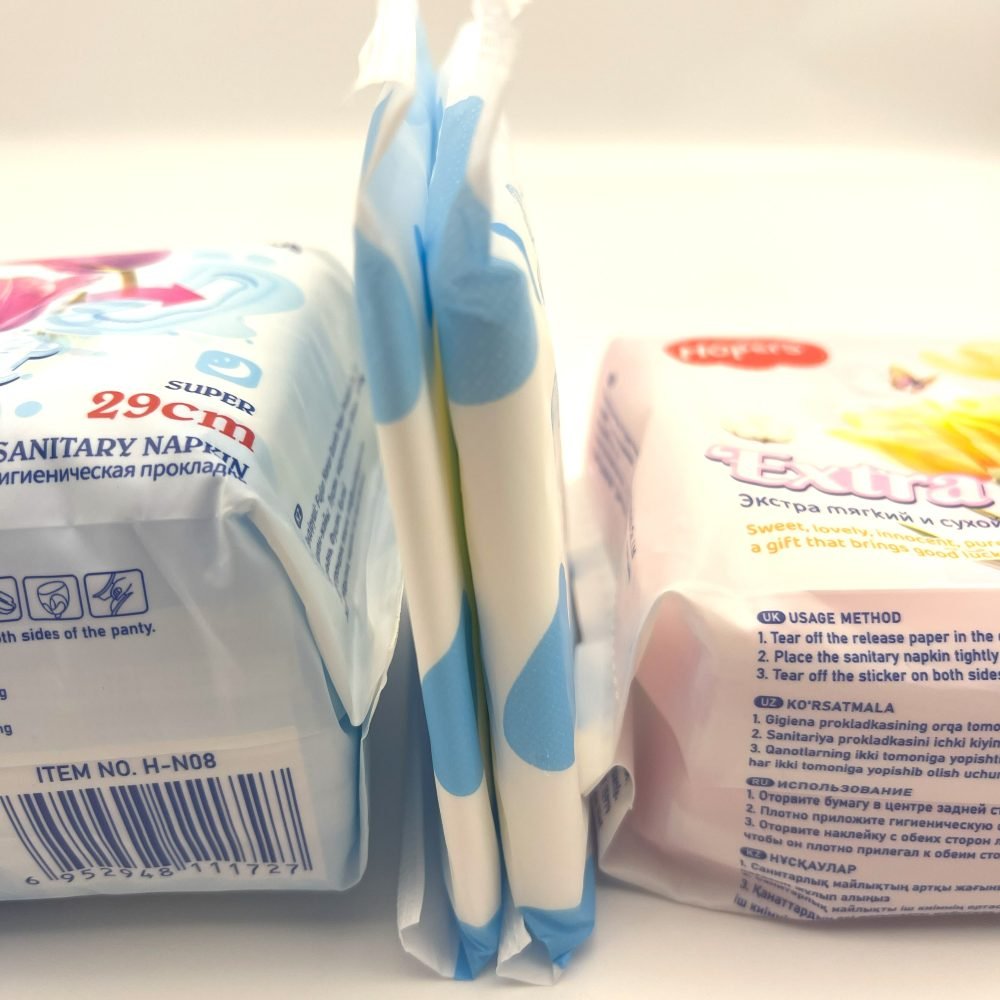
At New EcoCare, our sanitary pad OEM solutions can be customized around factors such as pad length, absorbency, topsheet and backsheet materials, core structure, thickness, surface pattern, individual wrapping, and retail packaging.
This gives brands room to build a product range without changing the fundamental usage format.
For example, a basic range could include:
- Day-use sanitary pads
- Longer or overnight pads
- Heavy-flow options
- Different pack counts
- Different material or surface options
For B2B buyers, another important consideration is SKU management.
A sanitary pad brand can often expand its range by changing relatively specific product variables rather than creating a completely different product format for every use case.
You can see an example of New EcoCare’s Частная этикетка женские гигиенические салфетки прокладки OEM поставщик to review the types of specifications and customization options available.
Where sanitary pads may fit into a brand portfolio
Sanitary pads can be considered when your business wants to:
- Build a broad everyday menstrual care range
- Serve customers already familiar with traditional pad formats
- Offer multiple absorbency and length options
- Develop several price or material positions
- Sell through supermarkets, pharmacies, distributors, wholesalers, or e-commerce
- Start with a relatively familiar product format before expanding into newer formats
The product is also easy for buyers to understand when developing retail packaging because the key product specifications can be communicated through familiar categories such as length, absorbency, wings, pack count, and usage period.
3. Period Pants: Product Characteristics and Brand Opportunities
Period pants take a different approach to menstrual protection.
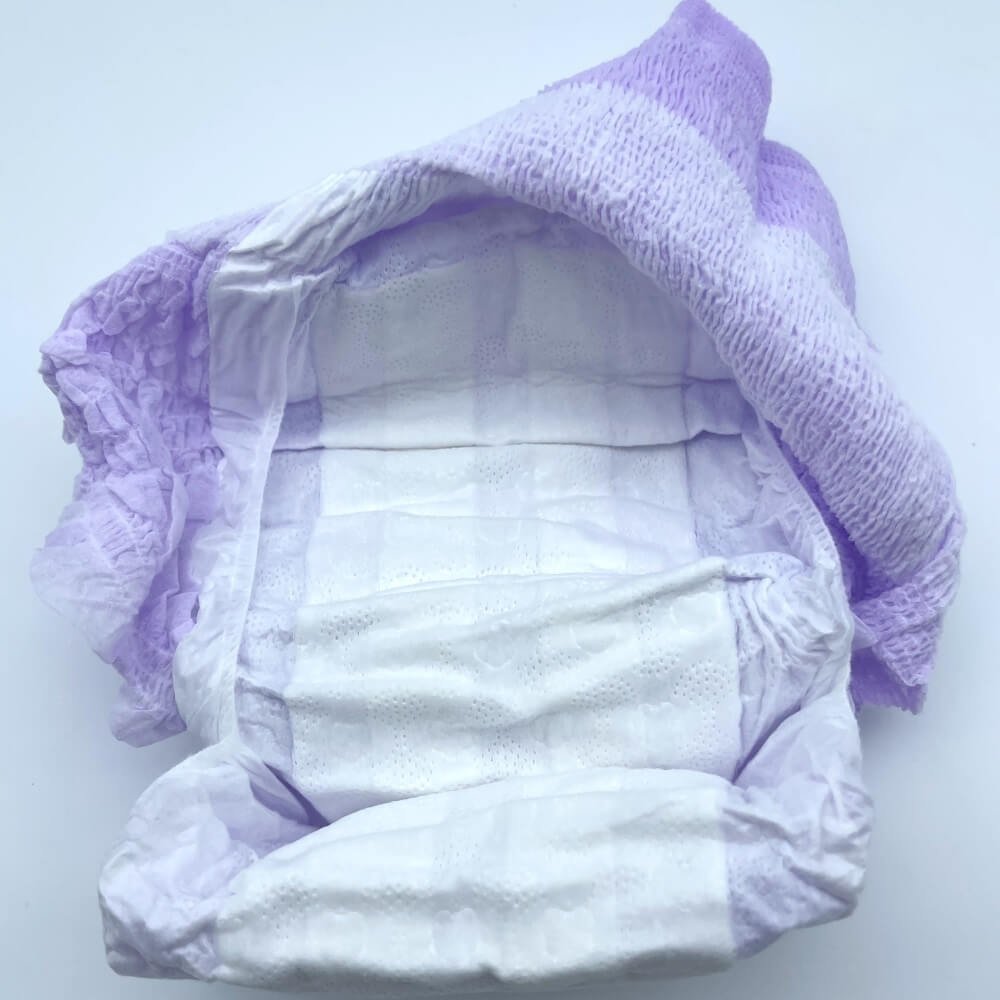
Instead of attaching a separate pad to underwear, the product itself has a pants-style construction with an absorbent core and protective layers.
This changes both the user experience and the way a brand needs to develop its product range.
For a private label period pants brand, fit becomes particularly important.
Sizing needs to correspond to the intended hip range, while waistband elasticity, leg openings, absorbent area, leakage protection, and overall product construction all contribute to the finished product.
At New EcoCare, our disposable period pants can be developed with customized branding, packaging, sizing, absorbency, and product specifications.
For example, our Custom Brand Women’s Disposable Period Pants page shows an example of a B2B period pants product, including M-L and XL specifications and an absorbency specification of 200 ml.
Period pants can be particularly relevant when a brand wants to offer:
- Full-coverage menstrual protection
- Day or night-use options
- Products positioned around convenience
- A pants-style alternative to traditional pads
- A more differentiated product within a feminine care portfolio
- A product suitable for specific use situations such as travel or overnight use
However, the product range needs to be planned carefully because adding more sizes can quickly increase SKU complexity.
4. Sanitary Pads vs. Period Pants: Key Differences
When comparing sanitary pads vs period pants from a private label perspective, it helps to look beyond consumer preference.
| Consideration | Sanitary Pads | Period Pants |
|---|---|---|
| Product format | Pad worn with underwear | Pants-style disposable product |
| Familiarity | Very familiar product format | Requires more product education in some markets |
| Sizing | Mainly based on pad dimensions/length | Requires body/hip size considerations |
| Впитываемость | Multiple levels and lengths | Multiple absorbency levels can be developed |
| Подходит | Depends on pad shape, wings, and underwear | Strongly influenced by waist and leg fit |
| SKU structure | Can expand by length, absorbency, pack count, etc. | Size adds an important SKU variable |
| Упаковка | Individual wraps, bags, boxes, multi-packs | Bags, boxes, and other retail formats |
| Позиционирование продукта | Everyday, overnight, heavy-flow, material-focused | Full-coverage, convenience, overnight, alternative format |
| OEM изготовление на заказ | Core, topsheet, backsheet, size, shape, packaging | Core, materials, size, waistband, absorbency, packaging |
| Распределение | Broad retail and wholesale applications | Retail, e-commerce, pharmacies, distributors, specialty channels |
The important point is that these differences affect your business model, not just the product itself.
A brand with a large distribution network may need a different SKU strategy from an e-commerce brand testing a new feminine care category.
5. Which Product Fits Different Target Markets?
There is no single product format that fits every market.
Instead, consider how your customers buy and use menstrual care products.
If your market values product familiarity
Sanitary pads may be easier to introduce because consumers already understand how the product works.
This can also simplify product communication and retail packaging.
If your brand focuses on overnight or full-coverage protection
Period pants can be considered as part of a product range designed around broader coverage and a pants-style wearing experience.
If you sell mainly through traditional retail
Sanitary pads may provide more flexibility for building multiple lengths, absorbency levels, and pack sizes within a familiar category.
If your brand is focused on e-commerce or product differentiation
Period pants can provide another format for expanding your feminine care portfolio and communicating a different product experience.
If you are building a broader menstrual care range
You do not necessarily have to choose one format permanently.
Many brands can structure their product portfolio around different consumer needs rather than treating sanitary pads and period pants as direct substitutes.
The key is to avoid launching more SKUs than your sales channels can realistically support.
6. Should a New Brand Launch One Product or Both?
For a new private label brand, launching both products at the same time can sound attractive.
But a larger product range also means more work.
You may need to manage:
- More product specifications
- More packaging designs
- More SKUs
- More samples
- More inventory
- More product photography
- More marketing content
- More sales training
- More production planning
For this reason, a new brand may decide to start with one core product format and expand later.
Another approach is to develop both products during the product-development stage but launch them in phases.
Например:
Phase 1: Launch the core sanitary pad range.
Phase 2: Add period pants after the brand has established distribution and customer demand.
Or:
Phase 1: Launch sanitary pads and one period pants SKU as a differentiated product.
Phase 2: Expand the period pants range after sales data shows which sizes and absorbency levels have demand.
The right structure depends on your market, sales channels, budget, and expected order volumes.
The important thing is to decide your portfolio architecture before finalizing packaging and production quantities.
7. What to Discuss With Your OEM Manufacturer
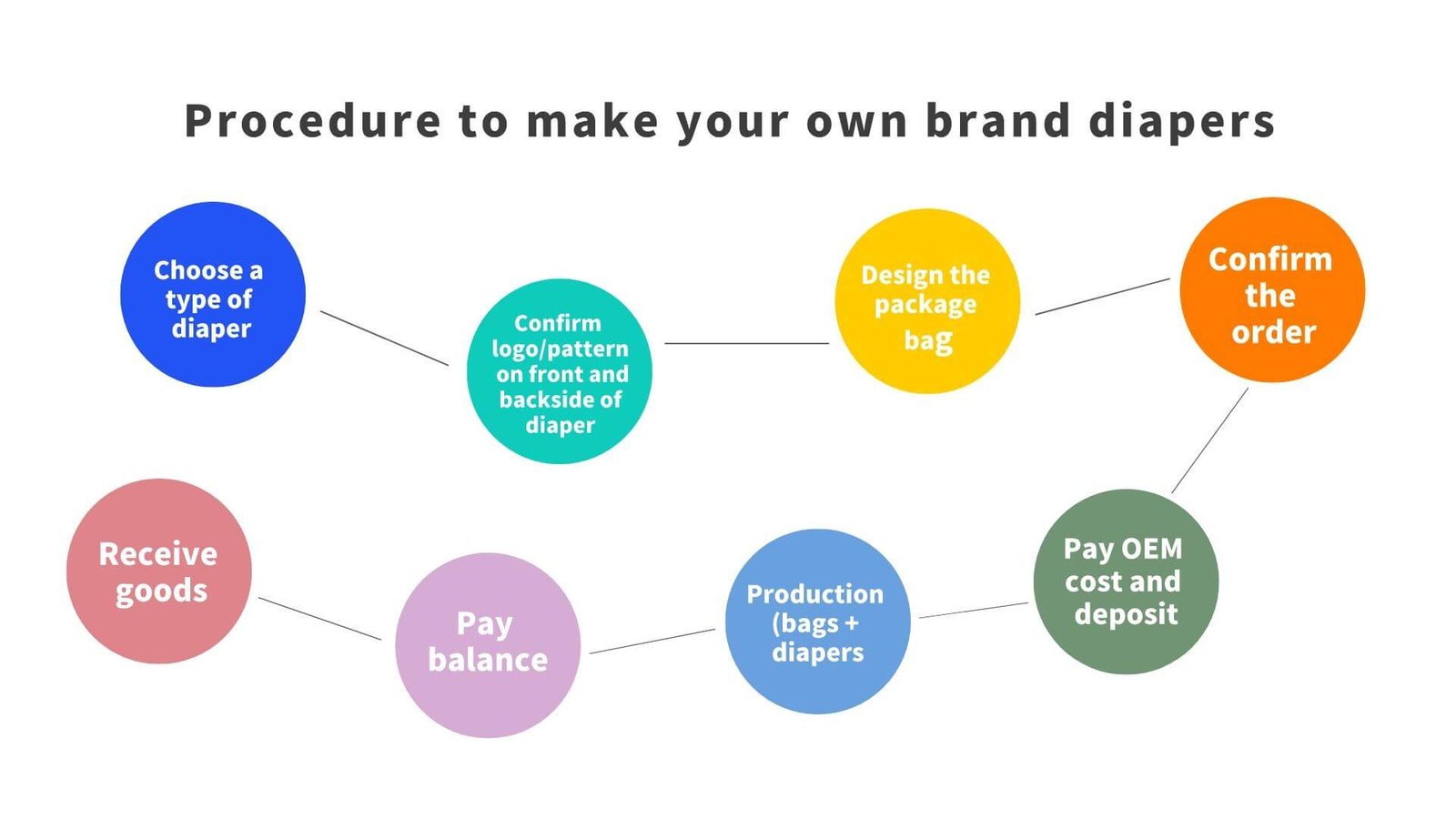
Once you have decided which product format fits your brand, the next step is to discuss the details with your manufacturer.
At New EcoCare, we recommend discussing the following before moving into final sampling.
1. Target customer and usage scenario
Tell your manufacturer who the product is for and where it will be sold.
A product intended for everyday retail use may require a different specification from one positioned around overnight or heavy-flow use.
2. Absorbency target
Do not simply ask for the highest possible absorbency.
Define the intended usage scenario first, then discuss the appropriate absorbent core structure and product dimensions.
3. Size and SKU plan
For sanitary pads, discuss:
- Length
- Shape
- Wings
- Толщина
- Впитываемость
- Pack count
For period pants, discuss:
- Size range
- Hip measurements
- Пояс на талии
- Leg openings
- Впитываемость
- Размеры изделия
4. Material positioning
Your OEM manufacturer should understand whether your brand is looking for a standard, premium, soft-touch, bamboo, cotton-related, or other material positioning.
The material decision should be connected to the product claims you intend to make on the packaging.
5. Packaging
Packaging can significantly affect SKU complexity and production planning.
Discuss whether you need:
- Индивидуальная упаковка
- Retail bags
- Paper boxes
- Multi-packs
- Different languages
- Customized artwork
- Barcodes
- Market-specific packaging
6. MOQ and production planning
Always confirm MOQ per SKU, size, and packaging format before finalizing the range.
A product portfolio that looks simple on paper can become much more complicated once every size, absorbency level, and packaging version is counted separately.
If you want to understand the supplier-selection side in more detail, see How to Choose the Right Sanitary Napkin Private Label Partner for Long-Term Brand Growth.
For period pants, you can also read Производитель женских трусиков - выбор правильного партнера для успеха B2B before starting your supplier discussion.
8. Final Checklist for Building Your Product Range
Before choosing between sanitary pads and period pants, review these questions with your team:
Market
- Who is the primary customer?
- What menstrual care formats are already familiar in the target market?
- Which distribution channels will you use?
- Is the product intended for mass-market, premium, specialty, or e-commerce positioning?
Продукт
- What usage scenario are you targeting?
- What absorbency level is required?
- How many sizes do you actually need?
- What materials and product features support your positioning?
SKU
- How many SKUs will you launch?
- Will different absorbency levels require separate SKUs?
- Will different sizes create additional SKUs?
- Can your inventory and distribution system handle the planned range?
Упаковка
- What pack counts are required?
- Do you need individual wrapping?
- Will you need multiple languages or market-specific packaging?
- Can the packaging clearly communicate the product difference?
Manufacturing
- Can your OEM manufacturer support the required specifications?
- What is the MOQ per SKU?
- What customization options are available?
- How will samples be evaluated before mass production?
- What quality checks should be agreed before production?
Building a Feminine Care Range Is More Than Choosing a Product
The comparison between sanitary pads vs period pants is ultimately a question of product-market fit and portfolio planning.
Sanitary pads offer a familiar format with many possibilities for length, absorbency, materials, pack sizes, and product positioning.
Period pants offer a different product structure centered around full coverage, fit, sizing, and convenience.
For some brands, one format may be the starting point. For others, the two products can serve different roles within the same menstrual care portfolio.
The important step is to define your target market, product positioning, SKU strategy, and manufacturing requirements before committing to a large product range.
New EcoCare supports B2B customers with OEM and private label feminine care manufacturing, including sanitary pads and disposable period pants. Our role is not simply to manufacture the finished product, but to work with brand owners, importers, distributors, and product teams to turn a product specification into a practical manufacturing plan.
To explore the broader product category, visit the New EcoCare Feminine Care Knowledge Center.
You can also review our Sanitary Napkins product range и period pants OEM products when comparing potential product directions.
Planning a private label feminine care product? Start with the product format, then work backward to the specification, SKU structure, packaging, and manufacturing plan.

 Russian
  English
  Spanish
  Arabic
  German
  French
  Italian
  Portuguese
  Greek
Greek