
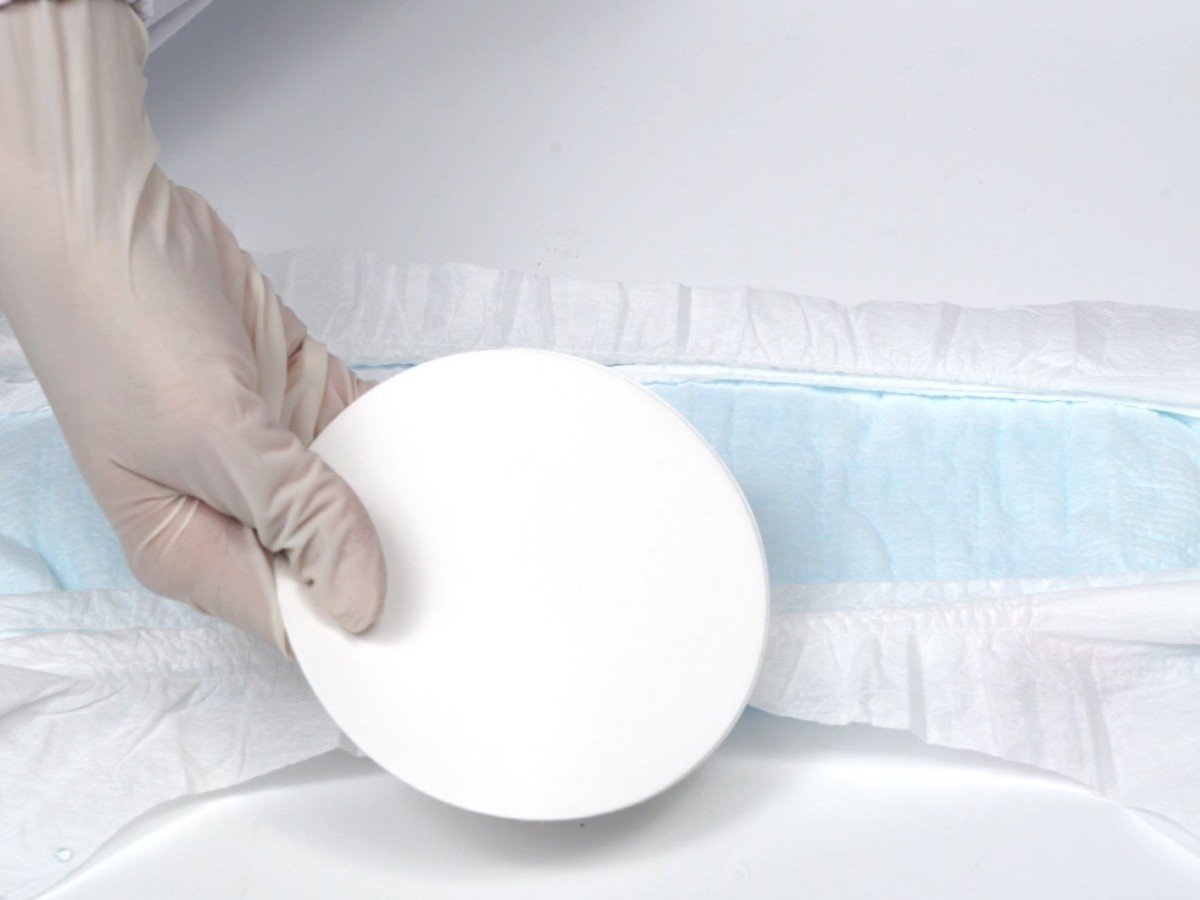
When buyers evaluate a baby diaper, absorbency is usually one of the first things they look at. But how much liquid a diaper can absorb is only part of the story.
A diaper can have strong absorption performance and still leave the surface feeling wet after pressure is applied. This is where baby diaper rewet testing becomes important.
Rewet testing looks at how much absorbed liquid can return toward the topsheet after the diaper has already taken in liquid. For private label brands, this provides useful information about surface dryness, absorbent core performance, and overall product quality.
If you are developing a new diaper line, understanding rewet can help you ask better questions during sample evaluation and communicate more clearly with your OEM manufacturer.
Оглавление
1. What Is Rewet in a Baby Diaper?
Rewet refers to the return of absorbed liquid toward the diaper surface after the liquid has already entered the absorbent core.
Проще говоря:
Liquid enters → diaper absorbs it → pressure is applied → some liquid may move back toward the surface.
That returned moisture is what buyers are concerned about when discussing diaper rewet.
For example, imagine a diaper has already absorbed urine. When a baby sits, crawls, sleeps, or moves around, pressure is placed on the absorbent core. If the core cannot retain the liquid effectively, some moisture may migrate back toward the topsheet.
The result can be a wetter surface.
This is different from simply asking how much liquid the diaper can absorb. Rewet is about liquid retention and surface dryness after absorption.
For buyers, this distinction is important because two diapers with similar absorbency results may provide different surface-dryness experiences.
To understand how rewet fits into the broader moisture-management system, see Moisture Management Technologies in Modern Baby Diapers.
2. Why Rewet Matters for Baby Skin and Comfort
Surface dryness is one of the most noticeable characteristics of a diaper.
Parents may never know how much SAP a diaper contains, how the absorbent core was engineered, or what type of acquisition layer was used. But they can notice whether the inside of the diaper feels wet after use.
This makes rewet especially relevant to private label diaper quality.
A diaper with good liquid retention can help reduce the amount of moisture remaining near the skin after absorption. Research has also found an association between skin wetness and diaper dermatitis, which is one reason surface dryness is an important consideration in diaper design. This can support a more comfortable wearing experience, particularly when a diaper is worn for an extended period.
However, it is important not to treat rewet as a direct guarantee of skin health. Skin condition depends on many factors, including wearing time, hygiene, fit, individual sensitivity, and the overall diaper environment.
For B2B buyers, the more practical question is:
Does the diaper retain absorbed liquid effectively enough to maintain the level of surface dryness expected for its intended market?
That is something testing can help answer.
3. What Causes Higher Rewet?
Rewet is rarely caused by one component alone.
It is usually related to how the topsheet, acquisition layer, absorbent core, SAP, fluff pulp, and overall diaper structure work together.
Several factors can influence rewet performance.
Absorbent Core Design
The absorbent core needs to receive, distribute, and retain liquid.
If liquid is not distributed effectively, some areas of the core may become highly saturated while other areas remain underused. Localized saturation can make liquid retention more difficult.
Core stability also matters. If the core structure becomes uneven after repeated wetting, liquid distribution and retention may change.
SAP Performance and Distribution
Super Absorbent Polymer, or SAP, is responsible for absorbing and retaining a significant amount of liquid inside the absorbent core.
But simply adding more SAP does not automatically solve every performance issue.
SAP distribution, core construction, liquid acquisition, and the interaction between absorbent materials all need to be considered together.
This is one reason diaper rewet should be evaluated as a product-structure issue rather than simply an SAP quantity issue.
Acquisition and Distribution Layer
The ADL sits between the topsheet and absorbent core.
Its role is to help move liquid away from the skin-contact area and into the absorbent structure.
If the liquid enters and spreads efficiently, the core can make better use of its available absorbent area. This can support better surface dryness and rewet control.
Topsheet Design
The topsheet is the layer closest to the baby’s skin.
It needs to allow liquid to pass through efficiently while helping maintain a relatively dry surface.
Therefore, topsheet material and structure can influence how quickly liquid moves away from the surface and how much moisture remains there after absorption.
For a deeper look at these components, read Baby Diaper Materials Explained: What Brand Owners Should Know Before Choosing a Product.
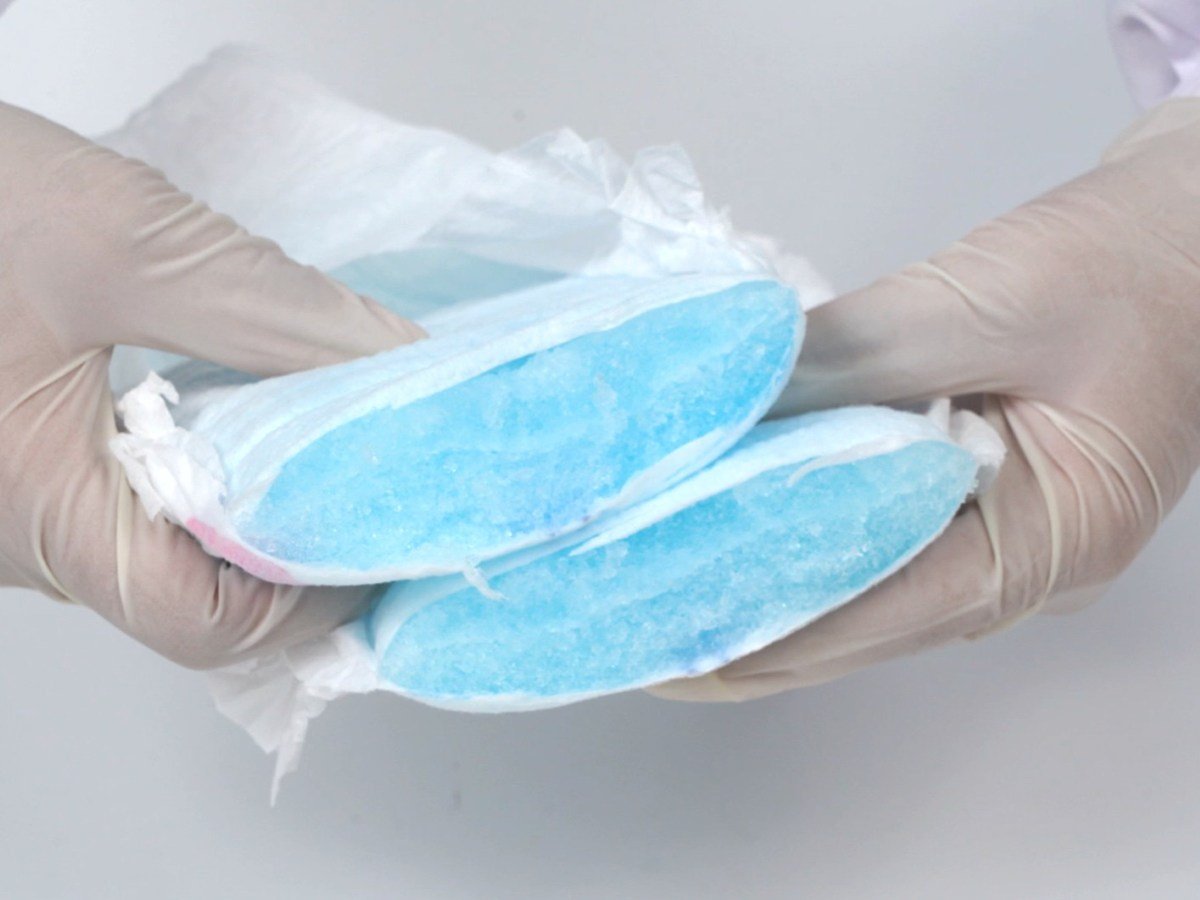
4. The Relationship Between Rewet and Absorbent Core Design
The absorbent core is at the center of rewet performance.
A well-designed core needs to do more than absorb liquid. It also needs to distribute that liquid and keep it retained after absorption.
A simplified moisture-management pathway is:
Liquid → Acquisition → Distribution → Absorption → Retention
Each stage matters.
If liquid acquisition is slow, moisture may remain near the surface for longer.
If distribution is poor, one area of the core may become saturated too quickly.
If absorption or retention is insufficient, more liquid may be available to move back toward the surface under pressure.
This is why experienced OEM teams look at the complete absorbent system rather than judging one material independently.
Traditional wood-pulp core diapers commonly combine fluff pulp and SAP. Ultra-thin designs can use different core constructions to reduce bulk while maintaining the required performance.
For brands considering different structures, you can also explore the Ультратонкие детские подгузники product range.
5. SAP, Absorption and Liquid Distribution
SAP plays an important role in modern disposable diapers because it absorbs and retains liquid within the core.
But absorption speed and rewet performance are not exactly the same thing.
A diaper may absorb liquid quickly during an initial test but still show different rewet behavior after the diaper becomes more heavily loaded.
That is why diaper absorbency testing should ideally be considered alongside other performance indicators.
For example, buyers may want to compare:
- Initial liquid acquisition
- Absorption after repeated loading
- Liquid distribution throughout the core
- Surface dryness
- Rewet after pressure
- Core stability after wetting
Looking at these results together gives a more useful picture than focusing on one number.
For buyers, the key point is simple:
More absorbency does not automatically mean less rewet.
The overall structure needs to be engineered as a system.
6. How Is Rewet Tested?
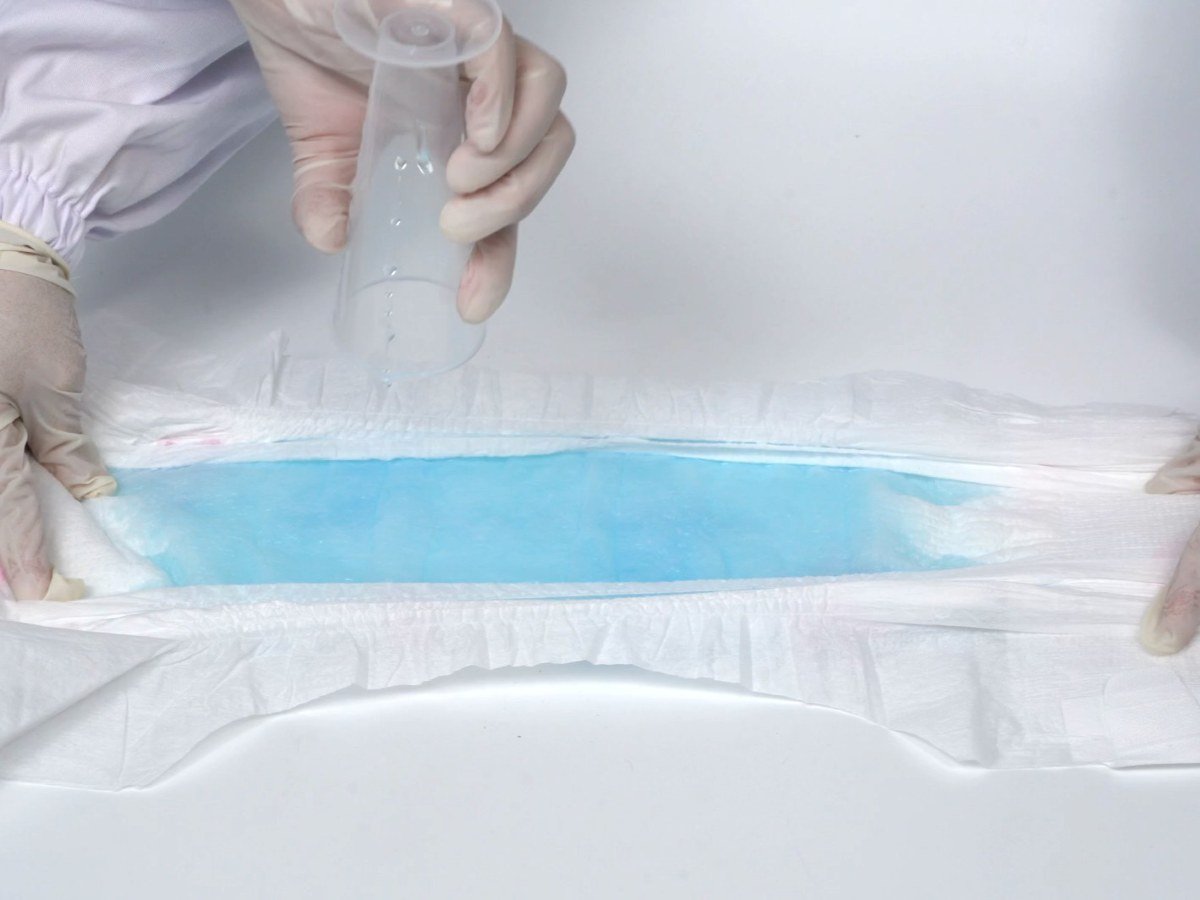
A typical rewet evaluation involves first introducing a controlled amount of liquid into a diaper sample and allowing the diaper to absorb it.
After absorption, pressure is applied to the wetted area. An absorbent material such as filter paper can then be used to assess how much liquid returns toward the surface.
The exact test method, liquid volume, timing, pressure, and equipment can vary depending on the laboratory or manufacturer’s testing protocol.
A simplified testing sequence is:
- Prepare the diaper sample.
- Apply a defined amount of test liquid.
- Allow the diaper to absorb the liquid.
- Apply controlled pressure to the wetted area.
- Place or use a suitable absorbent medium to collect returned moisture.
- Measure the amount of moisture transferred.
- Compare results between samples or against the agreed specification.
In general, a lower rewet result indicates less liquid returning toward the surface under the defined test conditions.
However, buyers should avoid comparing rewet numbers from different manufacturers unless the testing conditions are comparable.
A result is meaningful only when you understand how it was generated.
What Should Buyers Ask the OEM Manufacturer?
Instead of simply asking:
“What is your rewet value?”
ask:
- What test method do you use?
- What liquid is used?
- How much liquid is applied?
- How long is the absorption period?
- How is pressure applied?
- Where is the test performed?
- How many samples are tested?
- Is the test performed on samples from different batches?
- What is the acceptable specification for the product?
These questions help you understand whether the reported result can actually be used for supplier comparison and product validation.
7. Rewet vs Overall Absorbency
One of the most common mistakes in baby diaper performance testing is treating absorbency and rewet as the same measurement.
They are not.
Впитываемость generally looks at how much liquid the diaper can take in and retain under a defined test method.
Rewet focuses on how much liquid returns toward the surface after absorption when the diaper is subjected to pressure.
Think of it this way:
Absorbency asks:
“How much liquid can the diaper take in?”
Rewet asks:
“How much of that absorbed liquid comes back toward the surface under pressure?”
A good diaper development program therefore needs to consider both.
A product with high absorbency but poor liquid retention may not deliver the surface dryness expected by consumers.
Likewise, a diaper designed for low rewet still needs sufficient absorbency and leakage protection for its intended use.
This is why rewet is best treated as one part of a broader performance picture.
If you want to review the full range of performance indicators used before mass production, see How to Verify Baby Diaper Performance Before Mass Production: A Buyer’s Testing Guide.
8. What Private Label Brands Should Ask Their OEM Manufacturer
For private label brands, rewet testing becomes particularly useful during product development.
Rather than relying only on a supplier’s general statement that a diaper is “highly absorbent” or “ultra dry,” buyers can ask for specific information about how surface dryness is evaluated.
A useful OEM discussion can cover:
Testing Method
Ask the manufacturer to explain the rewet test procedure and testing conditions.
Sample Selection
Find out whether testing is performed on one sample or multiple samples.
Testing multiple samples can provide a better indication of consistency.
Product Specification
Ask whether a target rewet range or internal specification has been established for the product.
The target should reflect the product’s intended positioning and agreed performance requirements rather than an unsupported universal number.
Core Structure
Ask how changes to SAP, fluff pulp, ADL, core density, or core construction may influence rewet.
Batch Consistency
A good prototype is useful, but consistency during production is even more important for a private label brand.
Your manufacturer should be able to explain how product quality is monitored from raw materials through finished goods.
For a broader look at how sampling, production preparation, manufacturing, and quality control connect together, read How Does the OEM Baby Diaper Manufacturing Process Work? A Guide for Brand Owners.
9. How Rewet Results Can Support Product Development
Rewet testing is not only a quality-control tool. It can also help during product development.
Suppose a new diaper has acceptable absorbency but higher-than-expected rewet.
Instead of immediately adding more SAP, the development team can review the entire moisture-management system.
Possible areas to investigate include:
- Topsheet structure
- ADL design
- SAP distribution
- Absorbent core structure
- Core stability
- Распределение жидкости
- Product compression
- Overall diaper construction
This approach is often more effective than changing one material without understanding the underlying cause.
For private label brands, this can also help balance performance against commercial requirements.
A premium diaper may justify more advanced materials or a more sophisticated core structure.
A value-focused product may require a different balance between performance and manufacturing cost.
The objective is not necessarily to achieve the lowest possible rewet number at any cost.
The objective is to develop a product that delivers the right combination of dryness, absorbency, comfort, leakage protection, and cost for the target market.
10. Key Takeaways for Diaper Buyers
For baby diaper brands and OEM buyers, rewet is a small technical detail that can provide valuable insight into overall diaper performance.
The main points to remember are:
- Rewet measures liquid returning toward the surface after absorption and pressure.
- Lower rewet generally means less moisture returns to the surface under the defined test conditions.
- Rewet is different from total absorbency.
- SAP, fluff pulp, ADL, topsheet design, and core structure can all influence rewet.
- Testing conditions should be clearly defined before comparing results between suppliers.
- Multiple samples can provide a better picture of consistency than a single test.
- Rewet should be evaluated together with absorbency, leakage protection, fit, and other performance indicators.
- OEM buyers should ask manufacturers for the testing method, conditions, sample size, and product specification rather than relying on vague “ultra-dry” claims.
For a broader understanding of the baby diaper category, start with the Baby Care Knowledge Center. The Knowledge Center connects baby diaper materials, product performance, manufacturing, OEM development, and related product solutions into one resource for B2B buyers.
Часто задаваемые вопросы
Is rewet the same as diaper absorbency?
No. Absorbency measures how a diaper takes in and retains liquid under a defined test method, while rewet evaluates how much absorbed liquid returns toward the surface after pressure is applied.
Why is low rewet important for private label diapers?
Lower rewet can support a drier surface after absorption, which is an important part of the overall wearing experience. For private label brands, it can also provide a measurable product-development and quality-control indicator.
Does adding more SAP always reduce rewet?
Not necessarily. SAP quantity is only one factor. SAP distribution, core structure, liquid acquisition, and the interaction between different diaper layers can all influence rewet performance.
Should buyers test rewet during sample development?
Yes. Rewet can be included as part of a broader OEM baby diaper testing and sample-validation program, particularly when surface dryness is an important product requirement.
Can rewet results be compared between different OEM manufacturers?
They can be compared more meaningfully when the testing methods and conditions are equivalent. Buyers should ask manufacturers to provide details about the test method before comparing reported results.
Looking for a Reliable OEM Baby Diaper Partner?
At New EcoCare, we work with baby care brands, distributors, importers, and other B2B buyers to develop private label baby diapers based on specific product requirements.
From absorbent core construction and material selection to sample development, quality control, packaging, and mass production, product performance can be considered as part of the complete OEM development process.
Our baby diaper solutions include standard baby diapers, ultra-thin designs, and bamboo baby diapers for different market positions and product strategies.
Изучите наш Детские пеленки product range or discuss your requirements with our OEM team.
For brands interested in thinner product structures, explore Ультратонкие детские подгузники.
For brands developing a sustainability-focused baby care range, explore Бамбуковые подгузники для новорожденных.
A well-structured testing process can help you move from a promising sample to a product specification that is clearer, more measurable, and easier to control during mass production.

 Russian
  English
  Spanish
  Arabic
  German
  French
  Italian
  Portuguese
  Greek
Greek